Quotessence
Home / Quotes / Quote by Victor Hugo

Quote by Victor Hugo

“Astronomy, that micography of heaven, is the most magnificent of the sciences. ... Astronomy has its clear side and its luminous side; on its clear side it is tinctured with algebra, on its luminous side with poetry.”

Quote by Victor Hugo

Author
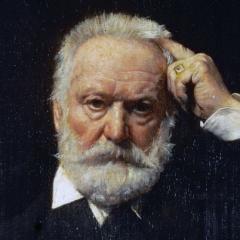
Victor Hugo
Victor Hugo

Victor Hugo, a French romantic poet, novelist, and playwright, was born on February 26, 1802, and died on May 22, 1885. He is considered one of the greatest writers in French literary history, known for his profound humanistic concerns and rich imagination. more

You May Also Like

“Geology does better in reclothing dry bones and revealing lost creations, than in tracing veins of lead and beds of iron; astronomy better in opening to us the houses of heaven than in teaching navigation; surgery better in investigating organiation than in setting limbs; only it is ordained that, for our encouragement, every step we make in science adds something to its practical applicabilities.”

“In science, probably ninety-nine percent of the knowable has to be discovered. We know only a few streaks about astronomy. We are only beginning to imagine the force and composition of the atom. Physics has not yet found any indivisible matter, or psychology a sensible soul.”

“My picture of the world is drawn in perspective and not like a model to scale. The foreground is occupied by human beings and the stars are all as small as three-penny bits. I don't really believe in astronomy, except as a complicated description of part of the course of human and possibly animal sensation. I apply my perspective not merely to space but also to time. In time the world will cool and everything will die; but that is a long time off still and its present value at compound discount is almost nothing.”

“Science only means knowledge; and for [Greek] ancients it did only mean knowledge. Thus the favorite science of the Greeks was Astronomy, because it was as abstract as Algebra. ... We may say that the great Greek ideal was to have no use for useful things. The Slave was he who learned useful things; the Freeman was he who learned useless things. This still remains the ideal of many noble men of science, in the sense they do desire truth as the great Greeks desired it; and their attitude is an external protest against vulgarity of utilitarianism.”