Quotessence
Home / Quotes / Quote by Dana Gioia

Quote by Dana Gioia

“The great and present danger to American literature is the growing homogeneity of our writers, especially the younger generation. Often raised in several places in no specific cultural or religious community, educated with no deep connection to a particular region, history, or tradition, and now employed mostly in academia, the American writer is becoming as standardized as the American car—functional, streamlined, and increasingly interchangeable.”

Quote by Dana Gioia

Work

The Catholic Writer Today: And Other Essays

Browse quotes and source details for this work. more

Author
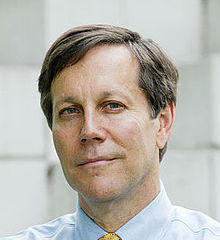
Dana Gioia
Dana Gioia

Dana Gioia, born on December 24, 1950, is an accomplished American poet known for his profound emotions and rich imagination in his works. more

You May Also Like

“Neem me niet kwalijk, maar dat ben ik niet met u eens. Velázquez is totaal niet dramatisch. Dat zijn Caravaggio en El Greco. Velázquez daarentegen is afstandelijk, rustig, hij schildert bij wijze van spreken met tegenzin, laat schilderijen half voltooid, kiest zelden het onderwerp uit, prefereert de statische figuur boven de bewegende scène, zelfs wanneer hij de beweging schildert, schildert hij die statisch, als bevroren in de tijd. Denk aan het ruiterportret van prins Baltasar Carlos: het paard is verstijfd in een sprong waaraan nooit een eind zal komen en de prins toont niet de inspanning van de ruiter. Velázquez zelf was een koelbloedig mens. Zijn persoonlijke leven is onbelangrijk, de politiek heeft hem nooit geïnteresseerd, zijn hele leven heeft hij doorgebracht aan het hof zonder deel te nemen aan de hofintriges, wat moeilijk is voor te stellen. Hij wilde liever ambtenaar zijn dan kunstenaar en toen hij eindelijk een hoge ambtelijke functie kreeg, stopte hij met schilderen, of zo goed als.” “Als men u zo hoort spreken,” zei de hertog, “zou niemand denken dat u het hebt over een kunstenaar van wereldfaam, een onbetwistbaar genie.”

“Hiring is hard. Letting go is harder. It’s far easier to hire the right person from the start than to hire the wrong person, realize they’re a bad fit for your company, and then figure out how to let them go. When you know what you want in a new hire, the hard part gets easier. And when you know how to protect your IP, you don’t have to learn the hard lesson.”

“If someone contacts you and asserts that you’re infringing on their patent, you’ll need a lawyer to shield you from the accusation that you are willfully infringing. Never, ever respond yourself. At the same time, you’re not left with whatever your lawyer tells you to do. If you have patents of your own (which you should), disputes don’t have to come to litigation, damages, and bankruptcy. In my experience, the best way to settle IP infringement suits out of the courtroom is through cross-licensing—an agreement between all parties to give each other a license to use their patents.”

“Intellectual property, more than ever, is a line drawn around information, which asserts that despite having been set loose in the world - and having, inevitably, been created out of an individual's relationship with the world - that information retains some connection with its author that allows that person some control over how it is replicated and used. In other words, the claim that lies beneath the notion of intellectual property is similar or identical to the one that underpins notions of privacy. It seems to me that the two are inseparable, because they are fundamentally aspects of the same issue, the need we have to be able to do something by convention that is impossible by force: the need to ringfence certain information. I believe that the most important unexamined notion - for policymakers and agitators both - in these debates is that they are one: you can't persuade people on the one hand to abandon intellectual property (a decision which, incidentally, would mean an even more massive upheaval in the way the world runs than we've seen so far since 1990) and hope to keep them interested in privacy. You can't trash privacy and hope to retain a sense of respect for IP.”