Quotessence
Home / Quotes / Quote by Temple Grandin

Quote by Temple Grandin

Work

The Autistic Brain: Thinking Across the Spectrum

Browse quotes and source details for this work. more

Author
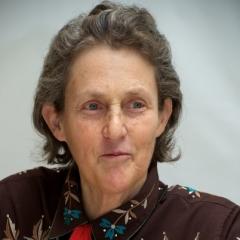
Temple Grandin
Temple Grandin

Temple Grandin is a professor of animal science and an autism advocate. Born on August 29, 1947, she has made significant contributions to the understanding of autism and animal welfare through her groundbreaking research. Grandin's innovative designs, such as the 'hug box,' have improved livestock handling practices. She is also an author and speaker, sharing her experiences and insights on autism and animal welfare with the world. more

You May Also Like

“I reached down to feel the soil, and I touched the outreaching roots of the trees that bore horizontally and vertically hundreds of feet through the forest. I stroked the earth with my palm, and I could almost feel that invisible network of capillary roots that sucks moisture and nutrients out of every inch of the soil I was standing on. I breathed in and out. I was part of the forest. I was alive.”

“Every engineer, doctor, and farmer on this ship has relatives on the waiting list, too, and those relatives won’t be drug addicts. Mom’s right: no one would pick her from a waiting list. No one would’ve picked me, either. Usefulness or death can’t be her only options. If being picked from the waiting list isn’t feasible, then the one choice left is to smuggle her in. The back of my mind keeps whispering about the risk, about She’d only be a drain, but I shut it up. There’s a difference between leaving Mom and leaving Mom to die. “I’m glad you agree,” Iris says. “I know it’s not easy.” That’s what I hate. She’s right. It’s not. I still don’t want to break the rules, even if it’s to help Mom. But people on TV never abandon their family; they risk their own lives. That’s what you’re supposed to do. On TV, people just never feel this twisted about it. “Four this afternoon,” I say. “Let’s talk.”

“I believe that disclosure represents a particular kind of inventional site within autism land. Because autism, in the cultural imagination, is an ambiguous and often mystery-laden construct, any disclosure around autism invokes questions, invokes guesswork, incites demands for particularity. One cannot claim autism without being pressed for more -- more information, more cross-examination, more refutation, more response, more words flowing from more mouths. But there is likewise a problem of ethos (or kakoethos, to quote Jenell Johnson) inherent in these disclosures, wherein autistic people are figured as lacking authority to speak on or from within autism. Autistic academic Dinah Murray laments these figurations of autism and ethos, noting, "Disclosure of an autism spectrum diagnosis means disclosure of the fundamentally flawed personhood implied by [autism's] diagnostic criteria. It is likely to precipitate a negative judgment of capacity involving permanent loss of credibility." In disclosing autism, we are both too autistic and not autistic enough...”