Quotessence
Home / Quotes / Quote by Gustave Eiffel

Quote by Gustave Eiffel

“The fundamental idea of these pylons, or great archways, is based on a method of construction peculiar to me, of which the principle consists in giving to the edges of the pyramid a curve of such a nature that this pyramid shall be capable of resisting the force of the wind without necessitating the junction of the edges by diagonals as is usually done.”

Quote by Gustave Eiffel

Author
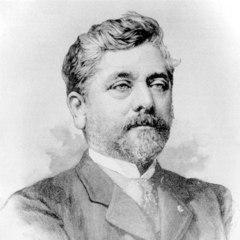
Gustave Eiffel
Gustave Eiffel

Gustave Eiffel was a renowned French civil engineer, best known for designing and constructing the Eiffel Tower. Born on December 15, 1832, and passing away on December 27, 1923, Eiffel had extensive experience in bridge and railway engineering. His design philosophy and techniques had a profound impact on modern architecture and engineering. more

You May Also Like

“The history of science, like the history of all human ideas, is a history of irresponsible dreams, of obstinacy, and of error. But science is one of the very few human activities-perhaps the only one-in which errors are systematically criticized and fairly often, in time, corrected. This is why we can say that, in science, we often learn from our mistakes, and why we can speak clearly and sensibly about making progress there. In most other fields of human endeavour there is change, but rarely progress ... And in most fields we do not even know how to evaluate change.”

“The members of the department became like the Athenians who, according to the Apostle Paul, "spent their time in nothing else, but either to tell or to hear some new thing." Anyone who thought he had a bright idea rushed out to try it out on a colleague. Groups of two or more could be seen every day in offices, before blackboards or even in corridors, arguing vehemently about these 'brain storms.' It is doubtful whether any paper ever emerged for publication that had not run the gauntlet of such criticism. The whole department thus became far greater than the sum of its individual members.”

“The scientific value of truth is not, however, ultimate or absolute. It rests partly on practical, partly on aesthetic interests. As our ideas are gradually brought into conformity with the facts by the painful process of selection,-for intuition runs equally into truth and into error, and can settle nothing if not controlled by experience,-we gain vastly in our command over our environment. This is the fundamental value of natural science”

“The truly scientific mind is altogether unafraid of the new, and while having no mercy for ideas which have served their turn or shown their uselessness, it will not grudge to any unfamiliar conception its moment of full and friendly attention, hoping to expand rather than to minimize what small core of usefulness it may happen to contain.”

“There are also two kinds of truths, those of reasoning and those of fact. Truths of reasoning are necessary and their opposite is impossible, and those of fact are contingent and their opposite is possible. When a truth is necessary its reason can be found by analysis, resolving it into more simple ideas and truths until we reach those which are primitive.”