Quotessence
Home / Quotes / Quote by Aleksandr Solzhenitsyn

Quote by Aleksandr Solzhenitsyn

“There is no way of sidestepping this comparison [between Nazism and Stalinism]: both the years and the methods coincide too closely. And the comparison occurred eve more naturally to those who had passed through the hands of both the Gestapo and the MGB. One of these was Yevgeny Ivanovich Divnich, and émigré and preacher of Orthodox Christianity. The Gestapo accused him of Communist activities among Russian workers in Germany, and the MGB charged him with having ties to the international bourgeoisie. Divnic's verdict was unfavorable to the MGB. He was tortured by both, but the Gestapo was nonetheless trying to get at the truth, and when the accusation did not hold up, Divnich was released. The MGB wasn't interested in the truth and had no intention of letting anyone out of its grip once he was arrested.”

Quote by Aleksandr Solzhenitsyn

Work

The Gulag Archipelago

Browse quotes and source details for this work. more

Author
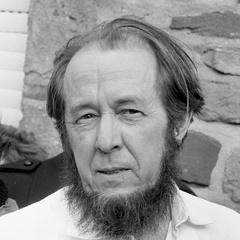
Aleksandr Solzhenitsyn

Aleksandr Solzhenitsyn, a Russian novelist, was born on December 11, 1918, and died on August 3, 2008. He is renowned for his works that profoundly exposed the dark side of the Soviet political system and is considered one of the greatest writers of the 20th century. more

You May Also Like

“For many months there day and night, at the morning and the evening checks, innumerable execution orders were read out. In a temperature of fifty below zero [Fahrenheit] the musicians from among the non-political offenders played a flourish before and after each order was read. The smoking gasoline torches ripped apart the darkness…. The thin sheet on which the order was written was covered with hoarfrost, and some chief or other who was reading the order would brush the snowflakes from it with his sleeve so as to decipher and shout out the name of the next man on the list of those shot.”

“A committed escaper! One who never for a minute doubts that a man cannot live behind bars—not even as the most comfortable of trusties, in the accounts office, in the Culture and Education Section, or in charge of the bread ration. One who once he lands in prison spends every waking hour thinking about escape and dreams of escape at night. One who has vowed never to resign himself, and subordinates every action to his need to escape. One for whom a day in prison can never be just another day; there are only days of preparation for escape, days on the run, and days in the punishment cells after recapture and a beating. A committed escaper! This means one who knows what he is undertaking. One who has seen the bullet-riddled bodies of other escapers on display along the central tract. He has also seen those brought back alive—like the man who was taken from hut to hut, black and blue and coughing blood, and made o shout: "Prisoners! Look at what happened to me! It can happen to you, too!" He knows that a runaway's body is usually too heavy to be delivered to camp. And that therefore the head alone is brought back in a duffel bag, sometimes (this is more reliable proof, according to the rulebook) together with the right arm, chopped off at the elbow, so that the Special Section can check the fingerprints and write the man off. A committed escaper! It is for his benefit that window bars are set in cement, that the camp area is encircled with dozens of strands of barbed wire, towers, fences, reinforced barriers, that ambushes and booby traps are set, that red meat is fed to gray dogs.”

“It should be said that all these years, in all the Special Camps, orthodox Soviet citizens, without even consulting each other, unanimously condemned the massacre of the stoolies, or any attempt by prisoners to fight for their rights. We need not put this down to sordid motives (though quite a few of the orthodox were compromised by their work for the godfather) since we can fully explain it by their theoretical views. They accepted all forms of repression and extermination, even wholesale, provided they came from above—as a manifestation of the dictatorship of the proletariat. Even impulsive and uncoordinated actions of the same kind but from below were regarded as banditry, and what is more, in its "Banderist" form (among the loyalists you would never get one to admit the right of the Ukraine to secede, because to do so was bourgeois nationalism). The refusal of the katorzhane to be slave laborers, their indignation about window bars and shootings, depressed and frightened the docile camp Communists.”

“Two Leningrad women were summoned to the police station. Had they been at a party with some men? Yes. Had sexual intercourse taken place? (This had already been established with the aid of a reliable informer.) Er—yes. Right, then, which is it: did you take part in the sexual act voluntarily or against your will? If voluntarily, we shall have to regard you as prostitutes, you will hand over your passports and get out of Leningrad in forty-eight hours. If it was against your will, you must bring a charge of rape! The women were not a bit anxious to leave Leningrad! So the men got twelve years each.”

“If the first thing you see each and every morning is the eyes of your cellmate who has gone insane, how then shall you save yourself during the coming day? Nikolai Aleksandrovich Kozyrev, whose brilliant career in astronomy was interrupted by his arrest, saved himself only by thinking of the eternal and infinite: of the order of the Universe - and of its Supreme Spirit; of the stars; of their internal state; and what Time and the passing of Time really are. And in this way he began to discover a new field in physics. And only in this way did he succeed in surviving in the Dmitrovsk Prison. But his line of mental exploration was blocked by forgotten figures. He could not build any further - he had to have a lot of figures. Now just where could he get them in his solitary-confinement cell with its overnight kerosene lamp, a cell into which not even a little bird could enter? And the scientist prayed: "Please, God! I have done everything I could. Please help me! Please help me continue!" At this time he was entitled to receive one book every ten days (by then he was alone in the cell). In the meager prison library were several different editions of Demyan Bedny's Red Concert , which kept coming around to each cell again and again. Half an hour passed after his prayer; they came to exchange his book; and as usual, without asking anything at all, they pushed a book at him. It was entitled A Course in Astrophysics! Where had it come from? He simply could not imagine such a book in the prison library. Aware of the brief duration of this coincidence, Kozyrev threw himself on it and began to memorize everything he needed immediately, and everything he might need later on. In all, just two days had passed, and he had eight days left in which to keep his book, when there was an unscheduled inspection by the chief of the prison. His eagle eye noticed immediately. "But you are an astronomer?" Yes." "Take this book away from him!" But its mystical arrival had opened the way for his further work, which he then continued in the camp in Norilsk.”

“So I ask, who you are meant to be versus who you’ve allowed yourself to become? You are built for more. You have underutilized your capabilities and accepted less of yourself throughout your journey thus far.”

“Krushchev himself is 'revealed' not as an honest communist but instead as a political leader seeking personal advantage while hiding behind an official persona of idealism and probity, a type familiar in capitalist countries. Taking into account his murder of Beria and the men executed as 'Beria's gang' in 1953, he seems worse still - a political thug. Krushchev was guilty IN REALITY of the kinds of crimes he DELIBERATELY AND FALSELY accused Stalin of in the 'Secret Speech'.”

“Events specially staged to demonstrate the reality of that which doesn’t exist stand out in the particular detail in which they are described. No one really knows, for example, whether the harvests reported in Stalin’s or Brezhnev’s Russia were ever actually reaped, but the fact that the number of tilled hectares or tons of milled grain was always reported down to the tenth of a percent gave these simulacra the character of hyperreality. [...] In this sense, the ideology was accurate—it was describing itself. And any reality that differed from the ideology simply ceased to exist—it was replaced by hyperreality, which trumpeted its existence by newspaper and loudspeaker and was much more tangible and reliable than anything else. In the Soviet land, “fairy tale became fact,” as in that American paragon of hyperreality, Disneyland, where reality itself is designed as a “land of imagination.”