Quotessence
Home / Quotes / Quote by Beverley Nichols

Quote by Beverley Nichols

“The Oldfields of the future are beyond hearing; they are shut up in the factories and the workshops, leading a rackety and mechanical existence, to the damage of their bodies and the peril of their souls, for the sake of an extra pound or so a week, which they promptly spend on mental or physical narcotics.”

Quote by Beverley Nichols

Work

Merry Hall

Merry Hall is a novel that delves into the lives of its characters within the confines of an English country house. The story revolves around the interactions and relationships between the inhabitants, highlighting the complexities of social class and the evolving nature of romance during the time period in which it is set. more

Author

Beverley Nichols
Beverley Nichols

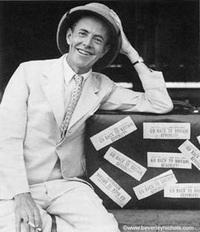
Beverley Nichols was a British author born on September 9, 1898, and died on September 15, 1983. Known for his works centered around rural life, Nichols is celebrated for his delicate pen and profound insight into nature. more

You May Also Like

“Reserved people often really need the frank discussion of their sentiments and griefs more than the expansive. The sternest-seeming stoic is human after all, and to burst with boldness and good-will into the silent sea of their souls is often to confer on them the first of obligations.”

“Some gentlemen have made an amazing figure in literature by general discontent with the universe as a trap of dulness into which their great souls have fallen by mistake; but the sense of a stupendous self and an insignificant world may have its consolations. Lydgate's discontent was much harder to bear; it was the sense that there was a grand existence in thought and effective action lying around him, while his self was being narrowed into the miserable isolation of egoistic fears, and vulgar anxieties for events that might allay such fears.”

“Truly, more than removing the partition between vectors and values, we would have needed to talk about strengthening crisscrossed lacings: an intertwined kind of understanding that would de-ideologize 'ideologies,' desanctify sanctities, but also mentalize the material bases of systems of inscription, and psychoanalyze not souls but tools. That is, in one and the same gesture, make our mnemo-technic equipment intelligible as mentality and our mental equipment intelligible as technology.”

“Memories do not change, and change is the law of existence. If our dead, the closest, the most beloved, were to return to us after a long absence and instead of the old, familiar trees were to find in our souls English gardens and stone walls - that is to say, other loves, other tastes, other interests, they would gaze upon us sadly and tenderly for a moment, wiping away their tears, and then return to their tombs to rest.”

“But when the door shuts on us, all that vanishes. The shell-like covering which our souls have excreted to house themselves, to make for themselves a shape distinct from others, is broken, and there is left of all these wrinkles and roughnesses a central oyster of perceptiveness, an enormous eye. How beautiful a street is in winter!”