Quotessence
Home / Quotes / Quote by H. G. Wells

Quote by H. G. Wells

“Rest enough for the individual man, too much and too soon, and we call it death. But for man, no rest and no ending. He must go on, conquest beyond conquest. First this little planet and all its winds and ways, and then all the laws of mind and matter that restrain him. Then the planets about him, and, at last, out across immensities to the stars. And when he has conquered all the deep space, and all the mysteries of time, still he will be beginning.”

Quote by H. G. Wells

Author
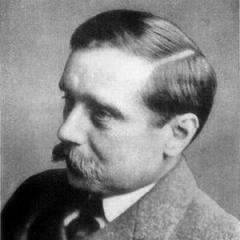
H. G. Wells
H. G. Wells

H.G. Wells was a prominent English writer known for his science fiction, history, and social commentary. His most famous works include 'The Time Machine,' 'The War of the Worlds,' and 'The Invisible Man.' Born on September 21, 1866, in Bromley, Kent, England, Wells passed away on August 13, 1946. more

You May Also Like

“In later life, as in earlier, only a few persons influence the formation of our character; the multitude pass us by like a distant army. One friend, one teacher, one beloved, one club, one dining table, one work table are the means by which one's nation and the spirit of one's nation affect the individual.”

“An old Arabian fable tells of a prince imprisoned in a castle which had thirteen windows. Twelve of these windows overlooked lovely scenes, while the thirteenth looked down on the black ash heaps of the city. Ignoring the twelve windows, the prince always looked out through the thirteenth. It is so often true that whether a person carries with him an atmosphere of gloom and depression or one of confidence and courage depends on his individual outlook.”

“We hear much nowadays as to the speculative ideas of men concerning the condition beyond the grave; but the admission that there is an individual existence beyond the grave, is a declaration that there must have been an individual, intelligent creation before we came here in the flesh. Life beyond the grave postulates a pre-existent state.”

“The inlet of a man's mind is what he learns; the outlet is what he accomplishes. If his mind is not fed by a continued supply of new ideas which he puts to work with purpose, and if there is no outlet in action, his mind becomes stagnant. Such a mind is a danger to the individual who owns it and is useless to the community.”

“The flight from study and awareness is much too common in a world that throws too many confusing pictures to the individual. For the sake of our democracy, based on freedom and individualism, we have to bring ourselves back to study again and again. Otherwise, we can become easy victims of a well-planned verbal attack on our minds and our consciences.”

“But if we believe what we profess concerning the worth of the individual, then the idea of individual development within a framework of ethical purpose must become our deepest concern, our national preoccupation, our passion, our obsession. We must think of education as relevant for everyone everywhere - at all ages and in all conditions of life.”