Quotessence
Home / Quotes / Quote by Voltaire

Quote by Voltaire

“There is an astonishing imagination, even in the science of mathematics. ... We repeat, there was far more imagination in the head of Archimedes than in that of Homer.”

Quote by Voltaire

Work

Voltaire – The Philosophical Works: Treatise On Tolerance, Philosophical Dictionary, Candide, Letters on England, Plato’s Dream, Dialogues, The Study of Nature, Ancient Faith and Fable, Zadig…: From the French writer, historian and philosopher, famous for his wit, his attacks on the established Catholic Church, and his advocacy of freedom of religion and freedom of expression

This compilation includes Voltaire's seminal essays on tolerance, his philosophical dictionary, the satirical novel Candide, and letters reflecting on English society. It also features dialogues, explorations of nature, and critical examinations of ancient faiths and fables. Voltaire's works are celebrated for their wit and criticism of the Catholic Church, as well as his defense of religious and expressive freedoms. more

Author
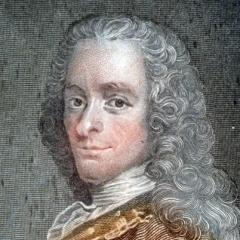
Voltaire
Voltaire

Voltaire, a French Enlightenment philosopher, writer, and thinker, was born on November 21, 1694, and died on May 30, 1778. He had a profound impact on philosophy, literature, and science in France and Europe with his sharp wit and critical spirit. more

You May Also Like

“There is nothing which Nature so clearly reveals, and upon which science so strongly insists, as the universal reign of law, absolute, universal, invariable law... Not one jot or tittle of the laws of Nature are unfulfilled. I do not believe it is possible to state this fact too strongly... Everything happens according to law, and, since law is the expression of Divine will, everything happens according to Divine will, i.e. is in some sense ordained, decreed.”

“There prevails among men of letters, an opinion, that all appearance of science is particularly hateful to Women; and that therefore whoever desires to be well received in female assemblies, must qualify himself by a total rejection of all that is serious, rational, or important; must consider argument or criticism as perpetually interdicted; and devote all his attention to trifles, and all his eloquence to compliment.”

“Though the parallel is not complete, it is safe to say that science will never touch them unaided by its practical applications. Its wonders may be catalogued for purposes of education, they may be illustrated by arresting experiments, by numbers and magnitudes which startle or fatigue the imagination but they will form no familiar portion of the intellectual furniture of ordinary men unless they be connected, however remotely, with the conduct of ordinary life.”

“Through it [Science] we believe that man will be saved from misery and degradation, not merely acquiring new material powers, but learning to use and to guide his life with understanding. Through Science he will be freed from the fetters of superstition; through faith in Science he will acquire a new and enduring delight in the exercise of his capacities; he will gain a zest and interest in life such as the present phase of culture fails to supply.”

“Thus science must begin with myths, and with the criticism of myths; neither with the collection of observations, nor with the invention of experiments, but with the critical discussion of myths, and of magical techniques and practices.”

“Thus science strips off, one after the other, the more or less gross materialisations by which we endeavour to form an objective image of the soul, till men of science, speculating, in their non-scientific intervals, like other men on what science may possibly lead to, have prophesied that we shall soon have to confess that the soul is nothing else than a function of certain complex material systems.”

“To be worthy of the name, an experimenter must be at once theorist and practitioner. While he must completely master the art of establishing experimental facts, which are the materials of science, he must also clearly understand the scientific principles which guide his reasoning through the varied experimental study of natural phenomena. We cannot separate these two things: head and hand. An able hand, without a head to direct it, is a blind tool; the head is powerless without its executive hand.”