Quotessence
Home / Quotes / Quote by Fulton J. Sheen

Quote by Fulton J. Sheen

“Help someone in distress and you lighten your own burden; the very joy of alleviating the sorrow of another is the lessening of one's own.”

Quote by Fulton J. Sheen

Author
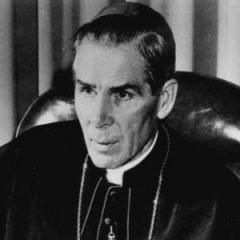
Fulton J. Sheen
Fulton J. Sheen

Fulton J. Sheen, an American television evangelist, was born on May 8, 1895, and passed away on December 9, 1979. Known for his unique charm and wisdom, he spread Christian faith to a global audience through his television programs, becoming one of the most influential religious leaders of the 20th century. more

You May Also Like

“The sovereignty of the state as the power that protects the individual and that defines the mutual relationships among the visible spheres, rises high above them by its right to command and compel. But within these spheres ... another authority rules, an authority that descends directly from God apart from the state. This authority the state does not confer but acknowledges.”

“I believe that every particle of dust that dances in the sunbeam does not move an atom more or less that God wishes - that every particle of spray that dashes against the steamboat has its orbit, as well as the sun in the heavens - that the chaff from the hand of the winnower is steered as the stars in their course. The creeping of an aphid over the rosebush is as much fixed as the march of the devastating pestilence - the fall of...leaves from a poplar is as fully ordained as the tumbling of an avalanche.”

“It would be easy to show that at our present rate of progress the kingdoms of this world never could become the kingdom of our Lord and of His Christ. Indeed, many in the Church are giving up the idea of it except on the occasion of the advent of Christ, which, as it chimes in with our own idleness, is likely to be a popular doctrine. I myself believe that King Jesus will reign, and the idols be utterly abolished. . . . The Holy Ghost would never suffer the imputation to rest upon His holy name that He was not able to convert the world.”

“I infer that God's decrees, and the necessity of event flowing thence, neither destroy the true free-agency of men, nor render the commission of sin a jot less heinous. They neither force the human will, nor extenuate the evil of human actions. Predestination, foreknowledge, and providence, only secure the event, and render it certainly future, in a way and manner (incomprehensibly indeed by us; but) perfectly consistent with the nature of second causes.”