Quotessence
Home / Quotes / Quote by William Crookes

Quote by William Crookes

“Which was first, Matter or Force? If we think on this question, we shall find that we are unable to conceive of matter without force, or force without matter. When God created the elements of which the earth is composed, He created certain wondrous forces, which are set free and become evident when matter acts on matter.”

Quote by William Crookes

Work

A course of six lectures on the various forces of Matter, and their relations to each other ... Edited by W. Crookes. With numerous illustrations

A comprehensive compilation of six lectures, edited by the renowned scientist W. Crookes, this book delves into the complex forces that govern matter. The lectures are accompanied by numerous illustrations to enhance the reader's comprehension of the subject matter. more

Author
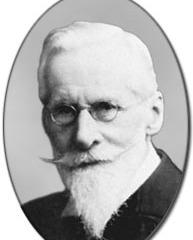
William Crookes
William Crookes

William Crookes, a British chemist, was born on June 17, 1832, and died on April 4, 1919. Known for his research in chemistry, physics, and astronomy, Crookes made significant contributions to the understanding of gas discharge and radioactivity, which had a profound impact on subsequent scientists. more

You May Also Like

“At any one time there is a natural tendency among physicists to believe that we already know the essential ingredients of a comprehensive theory . But each time a new frontier of observation is broached we inevitably discover new phenomena which force us to modify substantially our previous conceptions. I believe this process to be unending, that the delights and challenges of unexpected discovery will continue always.”

“It is possible to express the laws of thermodynamics in the form of independent principles , deduced by induction from the facts of observation and experiment, without reference to any hypothesis as to the occult molecular operations with which the sensible phenomena may be conceived to be connected; and that course will be followed in the body of the present treatise. But, in giving a brief historical sketch of the progress of thermodynamics, the progress of the hypothesis of thermic molecular motions cannot be wholly separated from that of the purely inductive theory.”

“In thermodynamics as well as in other branches of molecular physics , the laws of phenomena have to a certain extent been anticipated, and their investigation facilitated, by the aid of hypotheses as to occult molecular structures and motions with which such phenomena are assumed to be connected. The hypothesis which has answered that purpose in the case of thermodynamics, is called that of "molecular vortices," or otherwise, the "centrifugal theory of elasticity.”

“The laws of thermodynamics may be regarded as particular cases of more general laws, applicable to all such states of matter as constitute Energy , or the capacity to perform work, which more general laws form the basis of the science of energetics, a science comprehending, as special branches, the theories of motion, heat, light , electricity , and all other physical phenomena.”

“The hypothesis of molecular vortices is defined to be that which assumes - that each atom of matter consists of a nucleus or central point enveloped by an elastic atmosphere, which is retained in its position by attractive forces, and that the elasticity due to heat arises from the centrifugal force of those atmospheres revolving or oscillating about their nuclei or central points.According to this hypothesis, quantity of heat is the vis viva of the molecular revolutions or oscillations.”