Quotessence
Home / Quotes / Quote by James Madison

Quote by James Madison

“We are free today substantially, but the day will come when our Republic will be an impossibility. It will be an impossibility because wealth will be concentrated in the hands of a few. A Republic cannot stand upon bayonets, and when the day comes when the wealth of the nation will be in the hands of a few, then we must rely upon the wisdom of the best elements in the country to readjust the laws of the nations to the changed conditions.”

Quote by James Madison

Author
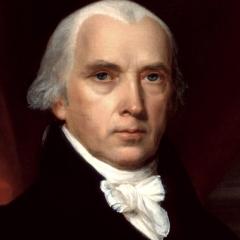
James Madison
James Madison

James Madison, the 4th President of the United States, was born on March 16, 1751, and died on June 28, 1836. He was a key figure in drafting the U.S. Constitution and had a profound impact on the political system of the United States. more

You May Also Like

“In Harlem, for instance, all of the stores are owned by white people, all of the buildings are owned by white people. The black people are just there - paying rent, buying the groceries; but they don't own the stores, clothing stores, food stores, any kind of stores; don't even own the homes that they live in. They are all owned by outsiders, and for these run-down apartment dwellings, the black man in Harlem pays more money than the man down in the rich Park Avenue section.”

“A democratic constitution, not supported by democratic institutions in detail, but confined to the central government, not only is not political freedom, but often creates a spirit precisely the reverse, carrying down to the lowest grade in society the desire and ambition of political domination.”

“In proportion as the people are accustomed to manage their affairs by their own active intervention, instead of leaving them to the government, their desires will turn to repelling tyranny, rather than to tyrannizing: while in proportion as all ready initiative and direction resides in the government, and individuals habitually feel and act as under its perpetual tutelage, popular institutions develop in them not the desire of freedom, but an unmeasured appetite for place and power.”

“A people among whom there is no habit of spontaneous action for a collective interest - who look habitually to their government to command or prompt them in all matters of joint concern - who expect to have everything done for them, except what can be made an affair of mere habit and routine - have their faculties only half developed; their education is defective in one of its most important branches.”

“The industrial economy which divides society absolutely into two portions, the payers of wages and the receivers of them, the first counted by thousands and the last by millions, is neither fit for, nor capable of, indefinite duration: and the possibility of changing this system for one of combination without dependence, and unity of interest instead of organized hostility, depends altogether upon the future developments of the Partnership principle.”

“If history could prove and teach us anything, it would be the private ownership of the means of production as a necessary requisite of civilization and material well-being. All civilizations have up to now been based on private property. Only nations committed to the principle of private property have risen above penury and produced science, art, and literature. There is no experience to show that any other social system could provide mankind with any of the achievements of civilization.”