Quotessence
Home / Quotes / Quote by Saint Augustine

Quote by Saint Augustine

“My mother spoke of Christ to my father, by her feminine and childlike virtues, and, after having borne his violence without a murmur or complaint, gained him at the close of his life to Christ.”

Quote by Saint Augustine

Author
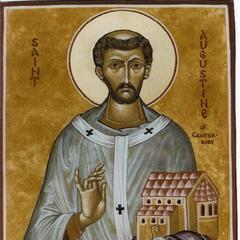
Saint Augustine
Saint Augustine

Saint Augustine, born on November 13, 354 in Tagaste, North Africa, and died on August 28, 430, was an influential Christian theologian, philosopher, and writer. He is considered one of the 'Fathers of the Church' and had a profound impact on Christian theology, philosophy, and Latin literature. His work 'Confessions' is a classic of Western literature, and his thoughts have had a lasting influence on Christian doctrine and Western culture. more

You May Also Like

“The Head and the body are Christ wholly and entirely. The Head is the only begotten Son of God, the body is His Church; the bridegroom and the bride, two in one flesh. All who dissent from the Scriptures concerning Christ, although they may be found in all places in which the Church is found, are not in the Church; and again all those who agree with the Scriptures concerning the Head, and do not communicate in the unity of the Church, are not in the Church.”

“Now, justification in this life is given to us according to these three things: first by the laver of regeneration by which all sins are forgiven; then, by a struggle with the faults from whose guilt we have been absolved; the third, when our prayer is heard, in which we say: 'Forgive us our debts,' because however bravely we fight against our faults, we are men; but the grace of God so aids as we fight in this corruptible body that there is reason for His hearing us as we ask forgiveness.”

“In our own times, you see, an emperor came to the city of Rome, where there's the temple of an emperor, where there's a fisherman's tomb. And so that pious and Christian emperor, wishing to beg for health, for salvation from the Lord, did not proceed to the temple of a proud emperor, but to the tomb of a fisherman, where he could imitate that fisherman in humility, so that he, being thus approached, might then obtain something from the Lord, which a haughty emperor would be quite unable to earn.”