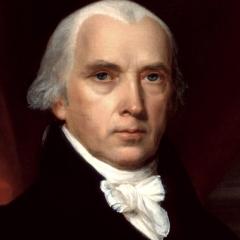
“No man is allowed to be a judge in his own cause; because his interest would certainly bias his judgment, and, not improbably, corrupt his integrity. With equal, nay with greater reason, a body of men are unfit to be both judges and parties at the same time.”
Quote by James Madison
“Inference is founded upon obvious reasons. Regard to reputation has a less active influence, when the infamy of a bad action is to be divided upon a number, than when it is to fall singly upon one. A spirit of faction . . . will often hurry the persons of whom they were composed into improprieties and excesses for which they would blush in a private capacity.”
Source: America's Founding Documents: The Declaration of Independence, the Articles of Confederation, the United States Constitution, the Federalist Papers, and the Bill of Rights
“Since it is impossible for the people spontaneously and universally, to move in concert towards their object; and it is therefore essential, that such changes be instituted by some informal and unauthorized propositions, made by some patriotic and respectable citizen or number of citizens.”
Source: The Federalist Papers: A Collection of Essays Written in Favour of the New Constitution
“It is possible that these may all be insufficient to control the caprice and wickedness of man. But are they not all that government will admit, and all that human prudence can devise?”
Source: The Fœderalist: A Collection of Essays, Written in Favor of the New Constitution, as Agreed Upon by the Fœderal Convention, September 17, 1787. Reprinted from the Original Text. With an Historical Introduction and Notes
“The smaller the number and the more permanent and conspicuous the station of men in power, the stronger must be the interest which they will individually feel in whatever concerns the government.”
Source: The Federalist Papers: A Collection of Essays Written in Favour of the New Constitution
“The necessity of a senate is not less indicated by the propensity of all single and numerous assemblies, to yield to the impulse of sudden and violent passions, and to be seduced by factious leaders, into intemperate and pernicious resolutions.”
Source: The federalist papers
“The important distinction so well understood in America between a constitution established by the people, and unalterable by the government; and a law established by the government, and alterable by the government, seems to have been little understood and less observed in any other country. Wherever the supreme power of legislation has resided, has been supposed to reside also, a full power to change the form of government.”
Source: The Federalist, on the New Constitution, Written in 1788
“As long as the reason of man continues fallible, and he is at liberty to exercise it, different opinions will be formed. As long as the connection subsists between his reason and his self-love, his opinions and passions will have a reciprocal influence on each other, and the former will be objects to which the latter attach themselves.”
Source: The Fœderalist: A Collection of Essays, Written in Favor of the New Constitution, as Agreed Upon by the Fœderal Convention, September 17, 1787. Reprinted from the Original Text. With an Historical Introduction and Notes
“This position will not be disputed so long as it is admitted that the desire of reward is one of the strongest incentives of human conduct, or that the best security for the fidelity of mankind is to make their interest coincide with their duty. Even the love of fame, the ruling passion of the noblest minds... would on the contrary deter him from the undertaking, when he foresaw that he must quit the scene before he could accomplish the work.”
“To presume a want of motives for such contests . . . would be to forget that men are ambitious, vindictive, and rapacious.”
Source: The federalist papers
“These are not vague inferences . . . but they are solid conclusions drawn from the natural and necessary progress of human affairs.”
Source: The federalist papers