Quotessence
Home / Quotes / Quote by Arthur C. Clarke

Quote by Arthur C. Clarke

Author

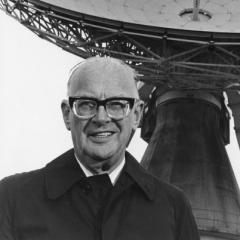
Arthur C. Clarke
Arthur C. Clarke

Arthur C. Clarke was a British science fiction author, writer, and science popularizer. Known for his science fiction novels and predictions about future technology, his most famous works include '2001: A Space Odyssey' and 'Rendezvous with Rama'. Clarke's science fiction novels are not only literarily valuable but also had a profound impact on science fiction films and television. more

You May Also Like

“The progression of physical science is much more connected with your prosperity than is usually imagined. You owe to experimental philosophy some of the most important and peculiar of your advantages. It is not by foreign conquests chiefly that you are become great, but by a conquest of nature in your own country.”

“The rigid electron is in my view a monster in relation to Maxwell's equations, whose innermost harmony is the principle of relativity... the rigid electron is no working hypothesis, but a working hindrance. Approaching Maxwell's equations with the concept of the rigid electron seems to me the same thing as going to a concert with your ears stopped up with cotton wool. We must admire the courage and the power of the school of the rigid electron which leaps across the widest mathematical hurdles with fabulous hypotheses, with the hope to land safely over there on experimental-physical ground.”

“There is more evidence to prove that saltness [of the sea] is due to the admixture of some substance, besides that which we have adduced. Make a vessel of wax and put it in the sea, fastening its mouth in such a way as to prevent any water getting in. Then the water that percolates through the wax sides of the vessel is sweet, the earthy stuff, the admixture of which makes the water salt, being separated off as it were by a filter.”

“There is one experiment which I always like to try, because it proves something whichever way it goes. A solution of iodine in water is shaken with bone-black, filtered and tested with starch paste. If the colorless solution does not turn the starch blue, the experiment shows how completely charcoal extracts iodine from aqueous solution. If the starch turns blue, the experiment shows that the solution, though apparently colorless, still contains iodine which can be detected by means of a sensitive starch test.”