Quotessence
Home / Quotes / Quote by Arthur Miller

Quote by Arthur Miller

“Pathos truly is the mode for the pessimist. But tragedy requires a nicer balance between what is possible and what is impossible. And it is curious, although edifying, that the plays we revere, century after century, are the tragedies. In them, and in them alone, lies the belief-optimistic, if you will, in the perfectibility of man.”

Quote by Arthur Miller

Work

The Collected Essays of Arthur Miller

This volume includes a selection of Arthur Miller's essays, offering insights into his perspectives on the art of theater, the social and political landscape of his time, and his personal reflections. The essays provide a glimpse into the mind of one of America's most influential playwrights, showcasing his intellectual depth and the evolution of his ideas over the years. more

Author
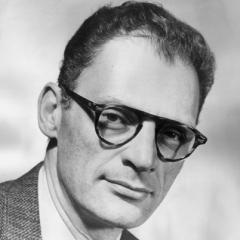
Arthur Miller
Arthur Miller

A renowned American playwright, known for his profound social criticism and character development. His works include 'Death of a Salesman' and 'All My Sons'. more

You May Also Like

“The suffering and calamity are, moreover, exceptional. They befall a conspicuous person. They are themselves of some striking kind. They are also, as a rule, unexpected, and contrasted with previous happiness or glory. A tale, for example, of a man slowly worn to death by disease, poverty, little cares, sordid vices, petty persecutions, however piteous or dreadful it might be, would not be tragic in the Shakespearean sense.”

“Such exceptional suffering and calamity, then, affecting the hero, and-we must now add-generally extending far and wide beyond him, so as to make the whole scene a scene of woe, are an essential ingredient in tragedy and a chief source of the tragic emotions, and especially of pity. But the proportions of this ingredient, and the direction taken by tragic pity, will naturally vary greatly.”

“The calamities of tragedy do not simply happen, nor are they sent; they proceed mainly from actions, and those the actions of men.We see a number of human beings placed in certain circumstances; and we see, arising from the co-operation of their characters in these circumstances, certain actions. These actions beget others, and these others beget others again, until this series of inter-connected deeds leads by an apparently inevitable sequence to a catastrophe.”

“A total reverse of fortune, coming unawares upon a man who 'stood in high degree,' happy and apparently secure,-such was the tragic fact to the mediaeval mind. It appealed strongly to common human sympathy and pity; it startled also another feeling, that of fear. It frightened men and awed them. It made them feel that man is blind and helpless, the plaything of an inscrutable power, called by the name of Fortune or some other name,-a power which appears to smile on him for a little, and then on a sudden strikes him down in his pride.”

“If we are to include the outer and the inner struggle in a conception more definite than that of conflict in general, we must employ some such phrase as 'spiritual force.' This will mean whatever forces act in the human spirit, whether good or evil, whether personal passion or impersonal principle; doubts, desires, scruples, ideas-whatever can animate, shake, possess, and drive a man's soul. [19]In a Shakespearean tragedy some such forces are shown in conflict.”