Quotessence
Home / Quotes / Quote by Martin Luther King, Jr.

Quote by Martin Luther King, Jr.

Work

I Have a Dream: The Quotations of Martin Luther King, Jr

This book compiles a selection of Martin Luther King, Jr.'s most influential and memorable quotes, offering a glimpse into his leadership and advocacy for civil rights and racial equality. The quotations are drawn from his speeches, sermons, and published works, showcasing his profound impact on American society and the struggle for civil liberties. more

Author
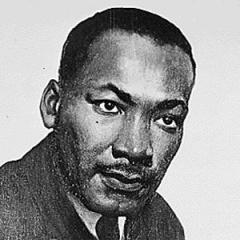
Martin Luther King, Jr.

Martin Luther King Jr. was an American civil rights activist known for his nonviolent protest and advocacy for equal rights. His 'I Have a Dream' speech at the Lincoln Memorial in 1963 became a significant milestone in the American civil rights movement. more

You May Also Like

“In the pre-Internet age you had to find gay things - or things that were slightly radioactive with erotic interest. You had to go to the library, you had to find the books; you had to find the coded things. When everything's available and everything's okay, what does it become? It becomes shopping. We're shopping all the time, basically, whether for objects, or people. On Manhunt or Grindr, or whatever. It's click to buy.”

“Shopping as lifestyle is really a sub-cultural problem. When the strictures that set you apart or oppressed you, disappear, is there a way, legitimately, to maintain your sense of specialness and difference? And how do you express that? Does it just become a kind of kitsch? You can say this of gay people, but it's true for Jewish people, Italian Americans, everyone who deals with it. It's a question of assimilation. How can you be assimilated and special at the same time?”

“I would argue, for perspective's sake, that the arc of a really literary work is precisely that it both intensely reflects, and simultaneously transcends the conditions of its making. I would say that is the difference between literature and other kinds of writing. That is what the literary is - it ultimately doesn't matter what his circumstances were. And the thing that you were just saying about being sympathetic to Brontë and the fact that she could only write what she wrote when she wrote it... that's true. But look at that novel, which means so much to so many people.”

“I have nothing but great respect for great scholars. But I was in grad school in the '80s and '90s, at the height of the theory craziness. It had a big part in why I ended up becoming a writer rather than a scholar, because I thought, "I just can't play these games." I was interested in literature because I loved literature, and so much of the theoretical positioning, at that moment 25 years ago, was antagonistic to literature. You know, trying to show that Jane Austen is a terrible person because she wasn't thinking about colonialism.”

“I was interested in all kinds of things, whether it be Avatar, Mad Men, Troy, 300, Battlestar Gallactica, or the poems of Horace and Sappho. I always joke about this to my students, who can't quite wrap their mind around the fact that you can have a Ph.D in classics, but not do that full time. I never wanted to write anything with footnotes for the rest of my life. I always think of what I do as the kind of conversation you'd have with somebody, like a good friend, when you've gone and seen a movie together, and you come home and you start talking about it.”