“We have been forced to admit for the first time in history not only the possibility of the fact of the growth and decay of the elements of matter. With radium and with uranium we do not see anything but the decay. And yet, somewhere, somehow, it is almost certain that these elements must be continuously forming. They are probably being put together now in the laboratory of the stars. ... Can we ever learn to control the process. Why not? Only research can tell.”
Quote by Robert Andrews Millikan
Author
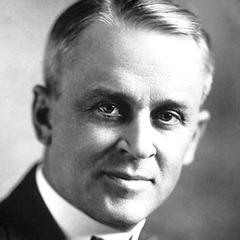
Robert Andrews Millikan
Robert Andrews Millikan was a renowned physicist known for his contributions to the precise measurement of the electron charge. In 1909, he was awarded the Nobel Prize in Physics for his work. Millikan's oil drop experiment was a landmark in this achievement, laying the foundation for the development of quantum mechanics. more
You May Also Like
Source: From My Life
Source: The letters of Faraday and Schoenbein 1836-1862: With notes, comments and references to contemporary letters
“A politician thinks of the next election. A statesman, of the next generation.”
Source: The Modern Library Collection of Greek and Roman Philosophy 3-Book Bundle: Meditations; Selected Dialogues of Plato; The Basic Works of Aristotle