Quotessence
Home / Quotes / Quote by Hermann Hesse

Quote by Hermann Hesse

“Love of God," he said slowly, searching for words, "is not always the same as love of good, I wish it were that simple. We know what is good, it is written in the Commandments. But God is not contained only in the Commandments, you know; they are only an infinitesimal part of Him. A man may abide by the Commandments and be far from God.”

Quote by Hermann Hesse

Author
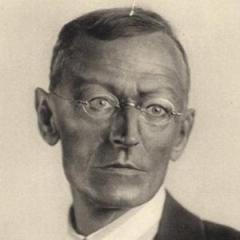
Hermann Hesse
Hermann Hesse

Hermann Hesse was a German poet and novelist, born on July 2, 1877, and died on August 9, 1962. Known for his profound psychological descriptions and exploration of human nature, his works include classics such as 'Steppenwolf' and 'The Glass Bead Game'. more

You May Also Like

“Als ein Schriftgelehrter Jesus einmal fragte, […]was nach seiner Meinung das grüßte Gebot im Gesetz sei, sagte er, es sei die Liebe zu Gott. Das zweite Gebot, man solle seinen Nächsten genauso lieben wie sich selbst, sei jedoch dem ersten gleich. Offenbar ging er davon aus, dass jeder sich selbst liebt; Menschenkenntnis war nicht gerade seine Stärke. In dieser Hinsicht mußte man erst noch auf den Juden aus Wien warten. Wer sich selbst nicht liebte oder gar hasste, durfte also dem zweiten ‚Wort’ zufolge auch seine Mitmenschen hassen, man durfte morden, wenn man dann auch Selbstmord verübte wie Judas oder Hitler. Von der Hölle hatte Jesus offenbar keine Ahnung, aber das war eigentlich klar: schließlich war er ein Wesen, das Gott liebte wie sich selbst. Aber der Kern seiner Antwort lag im Ist-Gleich-Zeichen, das er zwischen die fünf Gebote auf der einen und die fünf auf der anderen Tafel setzte; eines Tages formulierte er sogar eine positive Version der Goldenen Regel: ‚Was Du willst, das man dir tu, das füge auch dem andern zu, denn das ist das Gesetz und die Propheten.”

“The Hebrew original does not say, ‘Do not kill.’ It says, ‘Do not murder.’ Both Hebrew and English have two words for taking a life—one is “kill” (harag, , in Hebrew) and the other is “murder” (ratsach, , in Hebrew). Kill means: 1.Taking any life—whether of a human being or an animal. 2.Taking a human life deliberately or by accident. 3.Taking a human life legally or illegally, morally or immorally. On the other hand, murder can only mean one thing: The illegal or immoral taking of a human life. That’s why we say, ‘I killed a mosquito,’ not ‘I murdered a mosquito.’ And that’s why we would say, ‘The worker was accidentally killed,’ not ‘The worker was accidentally murdered.”

“So why did the King James translation of the Bible use the word ‘kill’ rather than ‘murder’? Because four hundred years ago when the translation was made, ‘kill’ was synonymous with ‘murder.’ As a result, some people don’t realize that English has changed since 1610 and therefore think that the Ten Commandments prohibit all killing. But, of course, they don’t. If the Ten Commandments forbade killing, we would all have to be vegetarians—killing animals would be prohibited. And we would all have to be pacifists—since we could not kill even in self-defense.”

“Do you know the Ten Commandments?" Grandma Trudie asked me. I nodded my head. Of course I knew the commandments God gave the Israelites at Sinai. I knew them by heart and in order. "What is commandment number six?" "Thou shalt not kill," I answered proudly. "Very good," Grandma Trudie said. "Then you will understand when I say that six million Jews were killed because the Nazis believed in their leader, Adolf Hitler, before anything else. When a human being is given the power to decide what is good and what is evil, the world is in chaos—crazy. Hitler said that certain people were not worthy of life, and his followers obeyed his orders without question. The Nazis showed us what kind of world we have when the Ten Commandments, God's laws, are disregarded.”