Quotessence
Home / Quotes / Quote by Maya Angelou

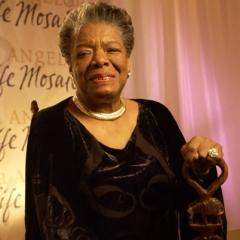
Quote by Maya Angelou

Author

Maya Angelou
Maya Angelou

Maya Angelou was an American author, poet, playwright, actress, and lecturer, known for her profound exploration of race, gender, and culture in her work. Her autobiographical works, including 'I Know Why the Caged Bird Sings,' which detailed her early life of poverty and sexual exploitation, have gained widespread acclaim. more

You May Also Like

“Theo's already on his way. Paul might bee too, but communications have been down so long, I don't know." "Heading out here with a storm like this coming in? That's madness." Dad sighs. "Then again, jumping through dimensions to chase a dead man is madness too. I had long suspected their lunacy but this confirmation is nonetheless disquieting." "See? Everything's going to be fine.”

“When faced with unbridled wildness of reality, dinosaurs fall into fevered delusions of grandeur. In fits of madness, they recreate the world in their own overblown image, bull-dozing the wild and replacing it with a wasteland that reflects their own emptiness. Where there was once the incredibly complex diversity of nature, there is now the dead simplicity of asphalt and concrete.”

“The bast, dispersing in shreds in the sunset whispered "Time has begun." The son, Adam, stripped naked, descended into the Old Testament of his native land and arrayed himself in bast; a wreath of roadside field grass he placed upon his brow, a staff, not a switch, he pulled from the ground, flourishing the birch branch like a sacred palm. On the road he stood like a guard. The dust-gray road ran into the sunset. And a crow perched there, perched and croaked, there where the celestial fire consumed the earth. There were blind men along the dust-gray road running into the twilight. Antique, crooken, they trailed along, lonely and sinister silhouettes, holding to one another and to their leader's cane. They were raising dust. One was beard-less, he kept squinting. Another, a little old man with a protruding lip, was whispering and praying. A third, covered with red hair, frowned. Their backs were bent, their heads bowed low, their arms extended to the staff. Strange it was to see this mute procession in the terrible twilight. They made their way immutable, primordial, blind. Oh, if only they could open their eyes, oh if only they were not blind! Russian Land, awake! And Adam, rude image of the returned king, lowered the birch branch to their white pupils. And on them he laid his hands, as, groaning and moaning they seated themselves in the dust and with trembling hands pushed chunks of black bread into their mouths. Their faces were ashen and menacing, lit with the pale light of deadly clouds. Lightning blazed, their blinded faces blazed. Oh, if only they opened their eyes, oh, if only they saw the light! Adam, Adam, you stand illumined by lightnings. Now you lay the gentle branch upon their faces. Adam, Adam, say, see, see! And he restores their sight. But the blind men turning their ashen faces and opening their white eyes did not see. And the wind whispered "Thou art behind the hill." From the clouds a fiery veil began to shimmer and died out. A little birch murmured, beseeching, and fell asleep. The dusk dispersed at the horizon and a bloody stump of the sunset stuck up. And spotted with brilliant coals glowing red, the bast streamed out from the sunset like a striped cloak. On the waxen image of Adam the field grass wreaths sighed fearfully giving a soft whistle and the green dewy clusters sprinkled forth fiery tears on the blind faces of the blind. He knew what he was doing, he was restoring their sight. ("Adam")”

“The winter drove them mad. It drove every man mad who had ever lived through it; there was only ever the question of degree. The sun disappeared, and you could not leave the tunnels, and everything and everyone you loved was ten thousand miles away. At best, a man suffered from strange lapses in judgment and perception, finding himself at the mirror about to comb his hair with a mechanical pencil, stepping into his undershirt, boiling up a pot of concentrated orange juice for tea. Most men felt a sudden blaze of recovery in their hearts at the first glimpse of a pale hem of sunlight on the horizon in mid-September. But there were stories, apocryphal, perhaps, but far from dubious, of men in past expeditions who sank so deeply into the drift of their own melancholy that they were lost forever. And few among the wives and families of the men who returned from a winter on the Ice would have said what they got back was identical to what they had sent down there.”