Quotessence
Home / Quotes / Quote by Winston Churchill

Quote by Winston Churchill

Author

Winston Churchill
Winston Churchill

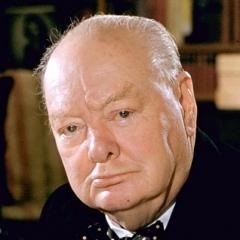
Winston Churchill, a former Prime Minister of the United Kingdom, was a statesman, historian, writer, and orator. He led the British people in resisting Nazi Germany during World War II and became a national hero. Churchill is renowned for his unique oratory style and steadfast political stance. more

You May Also Like

“Sunny was a treat to read. It is most appealing as the story is very well done and the artwork is beautiful. I applaud the author for writing a book to meet the needs of very young children as well as children of elementary school age. I experienced many different feelings as I read the book and I know otehrs will experience the same thing. The guide to further discussion at the end of teh book will be most helpful as foster parents read this story to the children in their care.”

“Otherwise, there were no long goodbyes or emotional scenes. That isn’t part of foster care. You just leave and you just die a little bit. Just a little bit because a little bit more of you understands that this is the way it’s going to be. And you grow hard around the edges, just a little bit. Not in some big way, but just a little bit because you have to, because if you don’t it only hurts worse the next time and a little bit more of you will die. And you don’t want that because you know that if enough little bits of you die enough times, a part of you leaves. Do you know what I mean? You’re still there, but a part of you leaves until you stand on the sidelines of life, simply watching, like a ghost that everyone can see and no one is bothered by. You become the saddest thing there is: a child of God who has given up.”

“I don’t know’,” he said. “Those three words from a willing soul are the start of a grand and magnificent voyage.” And with that he began a discourse that lasted for several weeks, covering scene-setting, establishing conflict, plot twists, and first- and third-person narration. [ I learned in these rapid-fire mini-dissertations that like most literature lovers I would come to know, Henry was a book snob. He assumed that if a current author was popular and widely enjoyed, then he or she had no merit. He made a few exceptions, such as Kurt Vonnegut, although that was mostly because Vonnegut lived on Cape Cod and so he probably had some merits as a human being, if not as a writer. I think that the way Henry saw it was that he was not being a snob. In fact I would venture that in his view of things, snobbery had nothing to do with it. Rather, it was a matter of standards. It was bout quality in the author’s craftsmanship.”

“So he sings,” he continued as if Denny had said nothing. “His solo mio, that with her in his life he is rich because she is so beautiful that she makes the sun more beautiful, you understand?” And at that he dropped the hoe, closed his eyes and spread out his arms wide and with the fading sun shining on his handsome face he sang: Che bella cosa è na jurnata 'e sole n'aria serena doppo na tempesta! Pe' ll'aria fresca pare già na festa Che bella cosa e' na jurnata 'e sole Ma n'atu sole, cchiù bello, oi ne' 'O sole mio sta 'nfronte a te! 'O sole, 'o sole mio sta 'nfronte a te! sta 'nfronte a te! It looked like fun. We dropped our tools and joined him, belting out something that sounded remarkably like Napolitano. We sang as loud as we could, holding on to each note as long as we could before we ran out of breath, and then we sang again, occasionally dropping to one knee, holding our hands over our hearts with exaggerated looks of deep pain. Although we made the words up, we sang with the deepest passion, with the best that we had, with all of our hearts, and that made us artists, great artists, for in that song, we had made all that art is: the creation of something from nothing, fashioned with all of the soul, born from joy. And as that beautiful summer sun set over Waterbury, the Brass City, the City of Churches, our voices floated above the wonderful aromas of the garden, across the red sky and joined the spirits in eternity.”

“It didn’t last long. Not many good things in a foster kid’s life last long. One day, Maura was gone. Her few things were packed in paper bags and a tearful Miss Louisa carried her out to Miss Hanrahan’s black state-owned Ford sedan with the state emblem on the door, and she was gone. The state had found a foster home that would take a little girl but couldn’t take the rest of us. There were no long goodbyes. She was just gone. I remember having an enormous sense of helplessness when they took her. Maura didn’t know where she were going or long she would be there. She was just gone”

“Jews were a frequent topic of conversation with all of the Wozniaks, which was surprising, since none of them had any contact at all with anything even remotely Jewish. While watching television, Walter would point out who was and who was not Jewish and Helen’s frequent comment when watching the television news was, “And won’t the Jews be happy about that!” To bargain with a merchant for a lower price was to “Jew him down,” and that sort of thing. Walter’s mother and father were far worse. They despised the Jews and blamed them for everything from the start of World War I to the Kennedy assassination to the rising price of beef. I didn’t pay much heed to any of this. It wasn’t my problem, and if I were to think through all the ethnic, racial and religious barbs the Wozniaks threw out in the course of a week, I’d think about nothing else. After being told about a part of my mother’s heritage, the Wozniaks began their verbal and cultural assault against us. As odd as it sounds, they might not always have intended to be mean.”

“One afternoon Walter brought Izzy to the house for lunch and, pointing to me, he said to Izzy, “He’s one of your tribe.” Dobkins lifted his head to look at me and after a few seconds said, “I don’t see it.” “The mother’s a Jew,” Walter answered, as if he were describing the breeding of a mongrel dog. “Then you are a Jew,” Izzy said, and sort of blessed me with his salami sandwich.”

“Father, I can’t take this,” I said. “Why not?” “Because you’re a priest, Father.” “And my money’s no good because of it? What are you? A member of the Masonic Lodge?” “Naw, Father,” I said. “I just feel guilty taking money from you.” “Well, you’re Irish and Jewish. You have to feel guilty over somethin’, don’t ya? Take the money and be happy ye have it.”