Quotessence
Home / Quotes / Quote by Victor Hugo

Quote by Victor Hugo

“In this age devoted to completing the French Revolution and to beginning the Human Revolution, equality between the sexes being part of equality between men, a great woman was needed. Woman had to prove that she could have all our manly qualities without losing her angelic ones: that she could be strong without ceasing to be gentle: George Sand is that proof. . . . she bequeathes to us the right of woman which draws its proof from woman's genius.. . . Thus the Revolution is fulfilled.”

Quote by Victor Hugo

Author
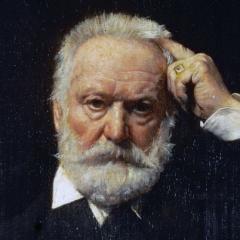
Victor Hugo
Victor Hugo

Victor Hugo, a French romantic poet, novelist, and playwright, was born on February 26, 1802, and died on May 22, 1885. He is considered one of the greatest writers in French literary history, known for his profound humanistic concerns and rich imagination. more

You May Also Like

“Russian realism was born in the second half of the forties. ... In substance it is a cross between the satirical naturalism of Gogol and an older sentimentalism revived and represented in the thirties and forties by the then enormously influential George Sand. Gogol and George Sand were the father and mother of Russian realism and its accepted masters during the initial stages.”

“These six tapestries, dated to the late fifteenth century, hail from a region near the French-Belgian border known for tapestry-weaving. They hung in relative obscurity in the Château de Boussac until the 1840s. Writer George Sand encountered the tapestries in central France, damp and neglected. She helped to have them cleaned, subsequently writing repeatedly about their subject and craftsmanship. Sand visited the town of Boussac regularly. In 1870, she wrote of an overnight stay at the château there. The night was windy and restless, sending Sand to fetch a forgotten letter from the salon. She described studying the lady and unicorn tapestries in the remaining light from the fire. “Thin, richly and bizarrely dressed,” she wrote, “This blond, stylish lady is quite mysterious.” Her granddaughter had called her “fairy-like.”

“Books devoted to France and its various regions became increasingly popular toward the later part of the July Monarchy. This growing preoccupation with France itself—perhaps best exemplified in the novels of George Sand—was a complex phenomenon, related at once to romantic nationalism, to improving communications within France, and to the retreat, after the 1830 revolution, of the legitimist nobility to their country estates, which contributed to making the countryside fashionable. Though by no means a new genre—they had been widely published since the middle of the eighteenth century—the travelogues had a wider audience than ever before during the July Monarchy because, like novels, they often appeared initially as installments in newspapers, to be published only later in book form. Thus, they were read by a broad segment of the public. Indeed, from upper to lower middle class, the French during the July Monarchy were a nation of enthusiastic armchair travelers.”

“At her best, no one has ever surpassed George Sand as the novelist of Nature, because her style pulsates with a natural vigor and music and because she was a countrywoman as well as a Romantic. Her range includes not only the mysteries and enchantments of distant horizons and perilous wanderings, of superstition and legend, of ecstatic (and often feminist) solitude; but also the closely observed and dearly loved realities of peasant life: the greeds and frugalities, the labor of the seasons, the farm animals and insects, the stolid silences of illiterate folk radiated with their music and dancing, their enchanting dialect speech. Her romans champêtres (La Mare au Diable, François le Champi, La Petite Fadette, Jeanne, Les Maîtres sonneurs, Le Meunier d'Angibault) are those of Sand's novels which have never gone completely out of fashion and to which the English country novelists (George Eliot and Thomas Hardy) were most in debt. But Sand had something her English imitators did not and that was her grasp of history. "Tout concourt à I'histoire," she wrote, "tout est I'histoire, meme les romans qui semblent ne se rattacher en rien aux situations politiques qui les voient eclore." Her country tales and her love stories take place in the churning past and the open future of a world of toppling regimes, shifting classes, and clashing ideologies.”

“The relationship between women and fiction extends also to the role of women as consumers of fiction. During the 1830s and 1840s, Russians who had any pretense of revering European culture formed a veritable cult in appreciation of the fiction of George Sand, originally Aurore Dupin Dudevant. So pervasively did Sand's work (and personal life) influence tsarist Russia that a special term was coined to describe the literary phenomenon. The term Zhorzhzandism was applied to the many Russian novels written in the 1830s and 1840s that dealt with themes similar to those of Sand's early novels. The international opera star Pauline Viardot attested to Sand's enormous popularity in Russia. She wrote to Sand that her works were immediately translated there from the time they first appeared, that everyone read them from the top rungs of the social ladder to the bottom, that the men adored her, the women idolized her—that, in short, she reigned over the Russian people more sovereignly than the tsar." Talk about Sand took the Russian literary salons by storm. Pushkin wrote in a letter to his wife, "If her [Evgenia Tur's] translation is as faithful as she herself is a faithful copy of Madame Sand, then her success is undoubtable." His letter reflected the fashionable attitude toward Sand in Russian high society. Diaries, memoirs and letters testify to her immense popularity among the Russian people and to the fact that young Russians seized each Sand novel as quickly as it arrived in their motherland, and devoured her prose. Almost all educated Russians in the nineteenth century read French fluently, but nonetheless many of her works were translated into Russian almost as quickly as they appeared in the original.”