Quotessence
Home / Quotes / Quote by Mother Teresa

Quote by Mother Teresa

Author

Mother Teresa
Mother Teresa

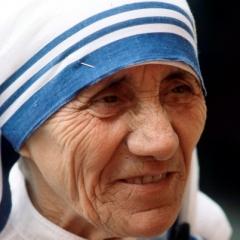
Mother Teresa, born Anjeze Gonxhe Bojaxhiu, was one of the most renowned religious figures of the 20th century. Born on August 26, 1910, in Albania, she passed away on September 5, 1997. She was the founder of the Missionaries of Charity in Calcutta, India, and is known for her selfless care for the poor and the sick. Mother Teresa was awarded the Nobel Peace Prize in 1979 and was canonized as a saint. more

You May Also Like

“For me, the most ironic token of [the first human moon landing] is the plaque signed by President Richard M. Nixon that Apollo 11 took to the moon. It reads: "We came in peace for all Mankind." As the United States was dropping 7 ½ megatons of conventional explosives on small nations in Southeast Asia, we congratulated ourselves on our humanity. We would harm no one on a lifeless rock.”

“There is so much I want to tell you, Ma. I was once foolish enough to believe knowledge would clarify, but some things are so gauzed behind layers of syntax and semantics, behind days and hours, names forgotten, salvaged and shed, that simply knowing the wound exists does nothing to reveal it. I don't know what I'm saying. I guess what I mean is that sometimes I don't know what or who we are. Days I feel like a human being, while other days I feel more like a sound. I touch the world not as myself but as an echo of who I was. Can you hear me yet? Can you read me?”

“The simplest truth about man is that he is a very strange being; almost in the sense of being a stranger on the earth. In all sobriety, he has much more of the external appearance of one bringing alien habits from another land than of a mere growth of this one. He cannot sleep in his own skin; he cannot trust his own instincts. He is at once a creator moving miraculous hands and fingers and a kind of cripple. He is wrapped in artificial bandages called clothes; he is propped on artificial crutches called furniture. His mind has the same doubtful liberties and the same wild limitations. Alone among the animals, he is shaken with the beautiful madness called laughter; as if he had caught sight of some secret in the very shape of the universe hidden from the universe itself. Alone among the animals he feels the need of averting his thought from the root realities of his own bodily being; of hiding them as in the presence of some higher possibility which creates the mystery of shame.”