Quotessence
Home / Quotes / Quote by Bhagat Singh

Quote by Bhagat Singh

Work

Bhagat Singh, on the path of liberation

This book delves into the life of Bhagat Singh, a key figure in the Indian independence movement, exploring his role in the fight against British colonialism. It covers his early life, his involvement in revolutionary activities, and his eventual sacrifice for the cause of Indian independence. more

Author
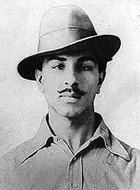
Bhagat Singh
Bhagat Singh

Bhagat Singh was an Indian national hero born on September 27, 1907, and died on March 23, 1931. He was a prominent nationalist known for his involvement in the struggle against British colonial rule. more

You May Also Like

“One should not interpret the word “Revolution” in its literal sense. Various meanings and significances are attributed to this word, according to the interests of those who use or misuse it. For the established agencies of exploitation it conjures up a feeling of blood stained horror. To the revolutionaries it is a sacred phrase.”

“Non-violence is backed by the theory of soul-force in which suffering is courted in the hope of ultimately winning over the opponent. But what happens when such an attempt fail to achieve the object? It is here that soul-force has to be combined with physical force so as not to remain at the mercy of tyrannical and ruthless enemy.”

“By Revolution, we mean the ultimate establishment of an order of society which may not be threatened by such breakdown, and in which the sovereignty of the proletariat should be recognized and a world federation should redeem humanity from the bondage of capitalism and misery of imperial wars.”

“If we want happiness, I think we should follow classic Greek wisdom and live with areté. The word directly translates as 'excellence' or 'virtue,' but has a deeper meaning — something closer to 'expressing the highest version of ourselves.' When we're showing up fully moment to moment, there's no room for regret/anxiety/disillusionment, just a whole lot of happiness. Here's to getting our areté on!”

“The world has never before had as much drama as today. Radio, films, television and video inundate us with drama. But while these forms can engage or even enrage the audience, in none of them can the viewer’s response alter the artistic event itselfThat is why theatre is signing its own death warrant when it tries to play too safe. On the other hand, that is also the reason why, although its future often seems bleak, theatre will continue to live and to provoke.”