Quotessence
Home / Quotes / Quote by Tom Robbins

Quote by Tom Robbins

“Time passed. Art came off the walls and turned into ritual. Ritual became religious. Religion spawned science. Science led to big business. And big business, if it continues on its present mindless, voracious trajectory, could land those of us lucky enough to survive its ultimate legacy back into caves again.”

Quote by Tom Robbins

Work

Villa Incognito

Villa Incognito is a work of fiction that delves into complex characters and their intricate relationships, set against the backdrop of a mysterious and darkly humorous narrative. more

Author

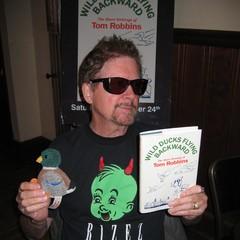
Tom Robbins
Tom Robbins

Tom Robbins (born July 22, 1936) is an acclaimed American novelist known for his whimsical, philosophical, and often surreal storytelling. His works blend pop culture, Eastern spirituality, and countercultural themes, with notable titles including 'Another Roadside Attraction' and 'Even Cowgirls Get the Blues'. Born in North Carolina, Robbins worked as a journalist and art critic before turning to fiction. His novels are celebrated for their linguistic playfulness, eccentric characters, and profound meditations on love, freedom, and the human condition. Though not a recipient of major literary prizes, he has cultivated a devoted global readership and influenced generations of writers. He remains a distinctive voice in contemporary American literature. more
You May Also Like

“At the entrance of one of the Hypogeum's painted rooms, the faint engraved impression of a large human hand, also arbitrarily assigned to the Neolithic, may still be seen. It 'has parallels in similar designs in Palaeolithic sites at Gargas, El Castillo, and particularly with Montespan in the Franco-Cantabrian region.' The impression shows a hand with six fingers [a condition known as Polydactyly that is also seen on at least one of the 'Fat Lady' figures on show in the National Museum of Archaeology].”

“Soon after the news broke about these published conclusions [regarding the evidence of a Palaeolithic human presence on Malta] and their stark contradiction of the orthodox view on Malta's prehistory, the Italian team distanced itself from its initial Palaeolithic leanings and claimed instead that the depictions in Ghar Hasan are 'out of context' -- which indeed they are if one is only prepared to countenance a Neolithic context for the earliest human presence in Malta. Another development at about the same time was that the Ghar Hasan cave began to be vandalized, and the paintings defaced or completely removed, a process that continued over a long period. The result, which would have caused an international furore anywhere else but Malta, is that today: 'The only depictions which have survived, unless more are obscured by stalagmitic material on the cavern walls, are the two handprints in red pigment in Gallery D ... Vandalism not of the popular type has destroyed and obscured the entire repertoire of images on the accessible areas.”

“Mifsud notes that J. D. Evans had graduated from Cambridge in 1949 and that in the early 1950s he was 'in desperate need of a PhD'. The thesis that the future Professor of Prehistoric Archaeology at the University of London chose to develop, influenced by the Italian archaeologist Barnarbo Brea, was that the very first human inhabitants of the previously unpeopled Malta had been immigrants from the Neolithic Stentinello culture of Sicily -- a theory that is still part of the conventional academic wisdom about Malta today. In pursuing this thesis, Mifsud suggests, it was not convenient to the young Evans to have to deal with the evidence of the Ghar Dalam teeth that suggested a prior, Palaeolithic, human presence in Malta. This, then, either as a conscious or unconscious motive, could explain why Evans was so vehement in his attacks on the antiquity of the taurodonts [that could belong to Neanderthals] and so economical with the truth in his published statements about them. He wanted them out of the way -- permanently -- of his own theory about Malta's first inhabitants.”

“…a short seven miles away is the Neolithic village called Skara Brae. There is preserved a huddle of roofless huts, dug half underground into midden and sand dune. There, you can marvel at the domestic normality, that late Stone Age people had beds and cupboards and neighbours and beads. You can feel both their presence, their day-to-day lives, and their utter absence. It’s a good place to go. It re-calibrates your sense of time.”

“Bruno eased one of the cheeses to the surface and inhaled. Instantly he was transported to the tiny pastures of the Castelli Romani, the hilly countryside around Rome. There was a touch of silage in the scent of the cheese, from winter feed, but there was fresh grass, too, and sunlight, and the faintest tang of thyme where it grew wild in the meadows and had been eaten by the sheep along with the grass. He didn't really need any more food, but the ricotta was so perfect that he knew he would find a place for it somewhere in his meal, perhaps served as a dessert with a dusting of cinnamon and a dab of sweet honey.”