Quotessence
Home / Quotes / Quote by Gerhard Richter

Quote by Gerhard Richter

Work

Gerhard Richter: writings 1961-2007

Gerhard Richter: writings 1961-2007 is a comprehensive compilation of the artist's written works over a significant period of his career. The book offers insights into Richter's evolving artistic philosophy, his approach to painting, and his reflections on the role of art in society. It is a valuable resource for those interested in the thoughts and ideas of one of the most influential contemporary artists. more

Author
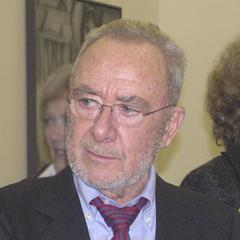
Gerhard Richter
Gerhard Richter

German visual artist known for his unique painting style and diverse creative techniques. Richter's works span a wide range of styles from abstraction to figuration, and his career has spanned over half a century, profoundly influencing contemporary art. more

You May Also Like

“... landscapes or still-lifes I paint in between the abstract works; they constitute about one-tenth of my production. On the one hand they are useful, because I like to work from nature - although I do use a photograph - because I think that any detail from nature has a logic I would like to see in abstraction as well.”

“The grey paintings, for example, a painted grey surface, completely monochromatic - they come from a motivation, or result from a state, that was very negative. It has a lot to do with hopelessness, depression and such things. But it has to be turned on its head in the end, and has to come to a form where these paintings possess beauty. And in this case, it's not a carefree beauty, but rather a serious one.”

“I believe I am looking for rightness. My work has so much to do with reality that I wanted to have a corresponding rightness. That excludes painting in imitation. In nature everything is always right: the structure is right, the proportions are good, the colours fit the forms. If you imitate that in painting, it becomes false.”

“These pictures possibly give rise to questions of political content or historical truth. Neither interests me in this instance. And although even my motivation for painting them is probably of no significance, I am trying to put a name to it here, as an articulation, parallel to the pictures, as it were, of my disquiet and of my opinion.”

“I wanted to say something different: the pictures are also a leave-taking, in several respects. Factually: these specific persons are dead; as a general statement, death is leave-taking. And then ideologically: a leave-taking from a specific doctrine of salvation and, beyond that, from the illusion that unacceptable circumstances of life can be changed by this conventional expedient of violent struggle.”

“And then the work bears a strong sense of leave-taking for me personally. It ends the work I began in the 1960s (paintings from black-and-white photographs), with a compressed summation that precludes any possible continuation. And so it is a leave-taking from thoughts and feelings of my own on a very basic level. Not that this is a deliberate act, of course; it is a quasi-automatic sequence of disintegration and reformation which I can perceive, as always, only in retrospect.”

“There was no special event that made me decide. I had collected some photos and the idea was in the back of my mind for a long time. It was growing and growing, so finally I said, 'I must paint this.' I come from East Germany and am not a Marxist, so of course at the time I had no sympathy for the ideas, or for the ideology that these people represented. I couldn't understand, but I was still impressed. Like everyone, I was touched. It was an exceptional moment for Germany.”