Quotessence
Home / Quotes / Quote by Leroy Chiao

Quote by Leroy Chiao

“You saw Britain back in the early days of sailing ships. They were the sea power, the controlled the seas and they had colonies all over the world and then you can look at history and watch the way that their empire kind of crumbled. I certainly don't want that to happen to the United States in space technology.”

Quote by Leroy Chiao

Author
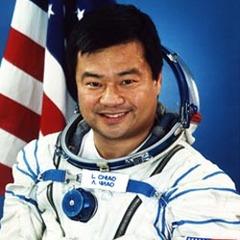
Leroy Chiao
Leroy Chiao

Leroy Chiao is an American engineer born on August 28, 1960. He is renowned for his exceptional contributions to the field of space exploration, serving as an astronaut for the National Aeronautics and Space Administration (NASA) and participating in multiple space missions. more

You May Also Like

“One of the things, and the most exciting, actually definitely the most exciting thing is, having children. You know, I didn't have children before. I had been married only a year before my space station mission, so having three-year-olds is a whole new experience and that's the new adventure. It may sound funny because people have kids every day, but having your own kids, having my own kids, was as fundamentally, or maybe even more fundamentally life changing then even flying in space.”

“The current market cost for a space flight, about a week in space and about six people have gone with the Russians so far to the International Space Station; it costs about $30 to $35 million. So, it's not for the faint of heart. But our own market studies that we've commissioned as well as some public market studies all indicate that there are somewhere around 20 or so individuals every year who have both the means and the interest to do this. So, the market is definitely out there.”

“Richard Branson is probably the most visible of the private commercial space guys, and what is venture, Virgin Galactic is about is sub orbital flight. That is, you'll see a spacecraft that looks more or less like an airplane and it will fly into space, but only spend about 15 minutes. It'll go up in a parabolic arc and then fall back down, and so the customers on that flight will only get about five minutes of weightlessness. They'll get to glimpse the horizon of the Earth, take a look at it before just before they start coming back down into the atmosphere.”

“Where we're operating is orbital adventures. We would offer five to seven days in low Earth orbit aboard our own spacecraft where customers would have the view of the Earth; get to experience really living in space, probably conducting some scientific investigations that we would piggyback onto those flights. So, they would have the whole experience, kind of a mini-experience of what professional astronauts have.”

“The Russians right now require a customer coming in and spending about six months or so in Russia and they have to learn some Russian. They have to learn some critical words so they can, in an emergency, at least have minimum communication with the Russian commander of the Soyuz. They also have to learn systems and I think this just evolved that way. They just thought, what is the minimum set of things we think we can train someone to be more or less competent in our systems? And so that's what these guys go through. So, it's not just like buying a ticket and getting on an airliner.”

“The expense of getting into space is the rocket launch, the rocket itself. Rocket's right now, commercial rockets cost probably somewhere between $50, or $120, or $150 million per launch. And those are all expendable. That is, you've got to buy a new rocket for each launch. So, that really is the critical part. If there was some kind of really, a revolutionary breakthrough and the price of rockets fell by an order of magnitude, I mean, just imagine what that would do as far as getting access to more ordinary people.”

“If you think about the energy that a rocket engine has to put out and all the fuel and you're sitting on top of like a bomb. And on the Space Shuttle, that big orange tank is filled with liquid hydrogen and liquid oxygen, the white cell rocket boosters on the sides are filled with solid propellant. There's a lot of energy in all those chemicals there and you've got to control it in a way so it doesn't explode. So, there's a lot of plumbing, a lot of valving, a lot of control systems, and it's a very complicated thing. So, how do you bring the price of that down?”

“The United States, Russia, and China are the only three countries in the world that can launch astronauts into space. Mostly in the U.S. you see some companies trying to launch private commercial people into space, but nobody's done it yet. The only private vehicle that's made it into space so far is Spaceship 1 in 2004, and that was an effort that was funded by one of the Microsoft founders, and he spent about $20 million to develop this spacecraft to do a sub-orbital flight. And it's not the same as going into orbit, but it was a huge first step.”

“If you increase the number of rockets you build and you buy, then it's the scale of the economy, the price is going to come down. It may not come down in order of magnitude, but if several commercial ventures start being successful and there becomes a bigger market for these rockets, the price will naturally come down a bit. That's why I think Excalibur Almaz, we're a little bit unique in that we don't look at our so-called competition with disdain, we want them to succeed and it needs to have more than one player. Even if we are successful, we couldn't handle the entire market ourselves.”

“One of the biggest concerns about going out beyond lower Earth orbit is the radiation. We find that exercise seems to counteract a lot of the negative effects of space flight, like bone loss and muscle atrophy and cardiovascular systems issues. We exercise two hours a day on the station, which is a huge hit out of your day. It's great for staying in shape, but you know, it cuts into the productivity of the crew and if you look at how expensive it is to get a crew into space, if we can keep them healthy and have them exercise, but spend less time doing it, we can get more done.”