Quotessence
Home / Quotes / Quote by Louis Armstrong

Quote by Louis Armstrong

Author

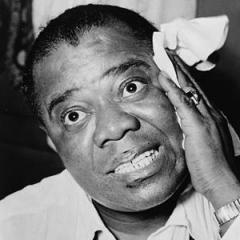
Louis Armstrong
Louis Armstrong

Louis Armstrong, born on August 4, 1901 in New Orleans, USA, was an outstanding jazz trumpeter, singer, and composer. Known as the 'Father of Jazz', he was renowned for his unique blues style and improvisational skills. Armstrong's musical career spanned over half a century, and his works had a profound impact on jazz and the music industry as a whole. more

You May Also Like

“Look, America is no more a democracy than Russia is a Communist state. The governments of the U.S. and Russia are practically the same. There's only a difference of degree. We both have the same basic form of government: economic totalitarianism. In other words, the settlement to all questions, the solutions to all issues are determined not by what will make the people most healthy and happy in their bodies and their minds but by economics. Dollars or rubles.”

“If we're ever going to get the world back on a natural footing, back in tune with natural rhythyms, if we're going to nurture the Earth and protect it and have fun with it and learn from it - which is what mothers do with their children - then we've got to put technology (an aggressive masculine system) in its proper place, which is that of a tool to be used sparingly, joyfully, gently and only in the fullest cooperation with nature. Nature must govern technology, not the other way around.”

“Certain individual words do possess more pitch, more radiance, more shazam! than others, but it's the way words are juxtaposed with other words in a phrase or sentence that can create magic. Perhaps literally. The word "grammar," like its sister word "glamour," is actually derived from an old Scottish word that meant "sorcery." When we were made to diagram sentences in high school, we were unwittingly being instructed in syntax sorcery, in wizardry. We were all enrolled at Hogwarts. Who knew?”

“In general, I've found female protagonists more intriguing to work with than males. I cherish women and have always preferred their company, reveling in their perfumes, their contours, their finer-grained sensibilities, lunar intuitions, nurturing instincts and relatively unfettered emotions--although I'm certainly not unaware that there are plenty of neurotic, uptight, stupid women in the world.”

“I think too much is known about me already. I think biographical information can get in the way of the reading experience. The interchange between the reader and the work. For example, I know far too much about Norman Mailer and Kurt Vonnegut. Because I know as much as I do about their personal lives, I can't read their work without this interjecting itself. So if I had it to do over, I'd probably go the way of J.D. Salinger or Thomas Pynchon. And just stay out of it altogether and let all the focus be on the work itself and not on me.”