Quotessence
Home / Quotes / Quote by Thomas Jefferson

Quote by Thomas Jefferson

“The error seems not sufficiently eradicated, that the operations of the mind, as well as the acts of the body, are subject to the coercion of the laws. But our rulers can have authority over such natural rights only as we have submitted to them. The rights of conscience we never submitted, we could not submit. We are answerable for them to our God. The legitimate powers of government extend to such acts only as are injurious to others.”

Quote by Thomas Jefferson

Work

The writings of Thomas Jefferson

This extensive compilation includes Jefferson's correspondence, his influential essays on topics such as democracy and individual rights, and his personal reflections on the founding of the United States. The writings provide insight into Jefferson's role in shaping American history and his contributions to the nation's political discourse. more

Author
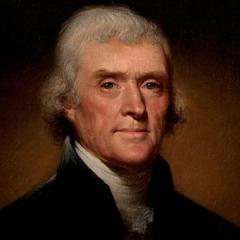
Thomas Jefferson
Thomas Jefferson

Thomas Jefferson was the third President of the United States, a distinguished politician, philosopher, architect, and scientist. He was born on April 13, 1743, and died on July 4, 1826. Jefferson advocated for democracy and freedom in politics and was one of the main authors of the Declaration of Independence. His political ideas had a profound impact on the founding and development of the United States. more

You May Also Like

“It is in the interest of tyrants to reduce the people to ignorance and vice. For they cannot live in any country where virtue and knowledge prevail. The religion and public liberty of a people are intimately connected; their interests are interwoven, they cannot subsist separately; and therefore they rise and fall together. For this reason, it is always observable, that those who are combin'd to destroy the people's liberties, practice every art to poison their morals.”

“Governments having failed the people, the people are entirely justified in assuming for themselves an essential role in government. Where a government takes proper measures to protect the people under its care, such a proceeding might have been thought both unnecessary and unjustifiable: But here it is quite the Reverse.”

“Character enough of an opposite description ... My opinion is ... that you could as soon scrub the blackamore white, as to change the principles of a profest Democrat; and that he will leave nothing unattempted to overturn the Government of this Country.”

“We have counted the cost of this contest, and find nothing so dreadful as voluntary slavery.-Honor, justice, and humanity, forbid us tamely to surrender that freedom which we received from our gallant ancestors, and which our innocent posterity have a right to receive from us. We cannot endure the infamy and guilt of resigning succeeding generations to that wretchedness which inevitably awaits them, if we basely entail hereditary bondage upon them.”

“In proportion to the value of this revolution; in proportion to the importance of instruments, every word of which decides a question between power and liberty; in proportion to the solemnity of acts, proclaiming the will authenticated by the seal of the people, the only earthly source of authority, ought to be the vigilance with which they are guarded by every citizen in private life, and the circumspection with which they are executed by every citizen in public trust.”

“As compacts, charters of government are superior in obligation to all others, because they give effect to all others. As truths, none can be more sacred, because they are bound, on the conscience by the religious sanctions of an oath. As metes and bounds of government, they transcend all other land-marks, because every public usurpation is an encroachment on the private right, not of one, but of all.”