Quotessence
Home / Quotes / Quote by Albert Einstein

Quote by Albert Einstein

Work

The Ultimate Quotable Einstein

This book compiles a vast array of quotes from Albert Einstein, showcasing his profound insights on science, philosophy, and life. more

Author
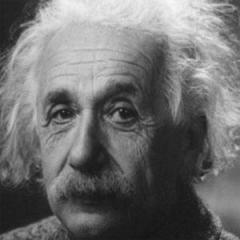
Albert Einstein
Albert Einstein

Albert Einstein, a German-born theoretical physicist, is renowned for his work on relativity and the photoelectric effect. His contributions revolutionized our understanding of the universe and had a profound impact on modern physics. more

You May Also Like

“Every scientist, through personal study and research, completes himself and his own humanity. ... Scientific research constitutes for you, as it does for many, the way for the personal encounter with truth, and perhaps the privileged place for the encounter itself with God, the Creator of heaven and earth. Science shines forth in all its value as a good capable of motivating our existence, as a great experience of freedom for truth, as a fundamental work of service. Through research each scientist grows as a human being and helps others to do likewise.”

“If a given scientist had not made a given discovery, someone else would have done so a little later. Johann Mendel dies unknown after having discovered the laws of heredity: thirty-five years later, three men rediscover them. But the book that is not written will never be written. The premature death of a great scientist delays humanity; that of a great writer deprives it.”

“James Watt patented his steam engine on the eve of the American Revolution, consummating a relationship between coal and the new Promethean spirit of the age, and humanity made its first tentative steps into an industrial way of life that would, over the next two centuries, forever change the world.”

“Malthus argued a century and a half ago that man, by using up all his available resources, would forever press on the limits of subsistence, thus condemning humanity to an indefinite future of misery and poverty. We can now begin to hope and, I believe, know that Malthus was expressing not a law of nature, but merely the limitation then of scientific and social wisdom. The truth or falsity of his prediction will depend now, with the tools we have, on our own actions, now and in the years to come.”

“Organs, faculties, powers, capacities, or whatever else we call them; grow by use and diminish from disuse, it is inferred that they will continue to do so. And if this inference is unquestionable, then is the one above deduced from it-that humanity must in the end become completely adapted to its conditions-unquestionable also. Progress, therefore, is not an accident, but a necessity.”