Quotessence
Home / Quotes / Quote by John Maynard Keynes

Quote by John Maynard Keynes

Work

The Economic Consequences of the Peace: The classic text on the Treaty of Versailles and post war Europe

This influential book delves into the economic repercussions of the Treaty of Versailles, examining its influence on the economic stability and recovery of Europe following World War I. more

Author
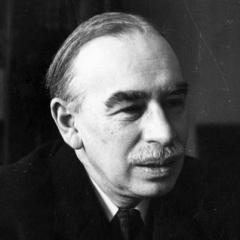
John Maynard Keynes
John Maynard Keynes

John Maynard Keynes, born on June 5, 1883, was a prominent British economist whose work had a profound impact on the field of economics, particularly in the area of macroeconomics. His theories advocating for government intervention to stabilize the economy gained widespread application during the Great Depression of the 1930s. more

You May Also Like

“A sound banker, alas, is not one who foresees danger and avoids it, but one who, when he is ruined, is ruined in a conventional and orthodox way along with his fellows, so that no one can really blame him. It is necessarily part of the business of a banker to maintain appearances, and to confess a conventional respectability, which is more than human. Life-long practices of this kind make them the most romantic and the least realistic of men.”

“In truth, the gold standard is already a barbarous relic. All of us, from the Governor of the Bank of England downwards, are now primarily interested in preserving the stability of business, prices, and employment, and are not likely, when the choice is forced on us, deliberately to sacrifice these to outworn dogma, which had its value once, of 3 pounds, 17 shill ings, 10 1/2 pence per ounce. Advocates of the ancient standard do not observe how remote it now is from the spirit and the requirements of the age. A regulated nonmetallic standard has slipped in unnoticed. It exists.”

“I do not mean to impugn the social justice and social expediency of the redistribution of incomes aimed at by N.I.R.A. and by the various schemes for agricultural restriction. The latter, in particular, I should strongly support in principle. But too much emphasis on the remedial value of a higher price-level as an object in itself may lead to serious misapprehension as to the part which prices can play in the technique of recovery. The stimulation of output by increasing aggregate purchasing power is the right way to get prices up; and not the other way round.”

“There will come a moment when the most urgent threats posed by the credit crisis have eased and the larger task before us will be to chart a direction for the economic steps ahead. This will be a dangerous moment. Behind the debates over future policy is a debate over history-a debate over the causes of our current situation. The battle for the past will determine the battle for the present. So it's crucial to get the history straight.”

“What people today call inflation is not inflation, i.e., the increase in the quantity of money and money substitutes, but the general rise in commodity prices and wage rates which is the inevitable consequence of inflation.”

“... Member Countries shall take necessary action and/or shall establish negotiations, individually or in groups, with the oil companies with a view to adopting ways and means to offset any adverse effects on the per barrel real income of Member Countries resulting from the international monetary developments as of 15th August 1971.”