Quotessence
Home / Quotes / Quote by Marcus Tullius Cicero

Quote by Marcus Tullius Cicero

Author

Marcus Tullius Cicero

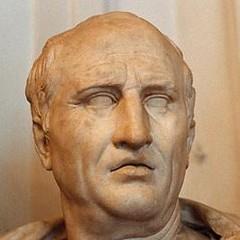
Marcus Tullius Cicero was a prominent philosopher, politician, lawyer, orator, and writer during the late Roman Republic. The exact dates of his birth and death are unknown, but he was active in the 1st century BC. Known for his profound thoughts and exceptional literary style, Cicero has had a lasting impact on Western culture. more

You May Also Like

“We have simply arrived too late in the history of the universe to see this primordial simplicity easily... But although the symmetries are hidden from us, we can sense that they are latent in nature, governing everything about us. That's the most exciting idea I know: that nature is much simpler than it looks. Nothing makes me more hopeful that our generation of human beings may actually hold the key to the universe in our hands - that perhaps in our lifetimes we may be able to tell why all of what we see in this immense universe of galaxies and particles is logically inevitable.”

“What a deep faith in the rationality of the structure of the world and what a longing to understand even a small glimpse of the reason revealed in the world there must have been in Kepler and Newton to enable them to unravel the mechanism of the heavens in long years of lonely work!”

“What the scientists have always found by physical experiment was an a priori orderliness of nature, or Universe always operating at an elegance level that made the discovering scientist's working hypotheses seem crude by comparison. The discovered reality made the scientists exploratory work seem relatively disorderly.”

“When every fact, every present or past phenomenon of that universe, every phase of present or past life therein, has been examined, classified, and co-ordinated with the rest, then the mission of science will be completed. What is this but saying that the task of science can never end till man ceases to be, till history is no longer made, and development itself ceases?”

“[Man] ... his origin, his growth, his hopes and fears, his loves and his beliefs are but the outcome of accidental collocations of atoms; that no fire, no heroism, no intensity of thought and feeling can preserve an individual life beyond the grave; that all the labour of the ages, all the devotion, all the inspiration, all the noonday brightness of human genius are destined to extinction in the vast death of the solar system, and that the whole temple of Man's achievement must inevitably be buried beneath the debris of a universe in ruins.”

“When Galileo discovered he could use the tools of mathematics and mechanics to understand the motion of celestial bodies, he felt, in the words of one imminent researcher, that he had learned the language in which God recreated the universe. Today we are learning the language in which God created life. We are gaining ever more awe for the complexity, the beauty, the wonder of God's most devine and sacred gift.”

“If we take an unprejudiced view of the processes of consciousness, free from all the so-called association rules and theories, we see at once that an idea is no more an even relatively constant thing than is a feeling or emotion or volitional process. There exist only changing and transient ideational processes ; there are no permanent ideas that return again and disappear again.”