Quotessence
Home / Quotes / Quote by Maimonides

Quote by Maimonides

“He who thinks he can have flesh and bones without being subject to any external influence, or any accidents of matter, unconsciously wishes to reconcile two opposites, viz., to be at the same time subject and not subject to change. If man were never subject to change there could be no generation; there would be one single being, but no individuals forming a species.”

Quote by Maimonides

Work

The Guide for the Perplexed

The Guide for the Perplexed is a comprehensive work that delves into the complexities of Jewish law and philosophy. Written by the medieval philosopher Moses Maimonides, it is a synthesis of Jewish thought and an attempt to reconcile religious beliefs with reason. The book is divided into three parts, each addressing different aspects of Jewish law and philosophy, and is known for its depth and intellectual rigor. more

Author
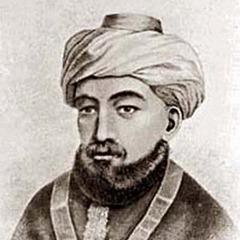
Maimonides
Maimonides

Maimonides, born on March 30, 1135 and died on December 12, 1204, was a Jewish philosopher, physician, and legal scholar. He is renowned for his contributions to philosophy, medicine, and Jewish law. more

You May Also Like

“Galen , in the third section of his book, "The Use of the Limbs," says correctly that it would be in vain to expect to see living beings formed of the blood of menstruous women and the semen virile, who will not die, will never feel pain, or will move perpetually, or shine like the sun. This dictum of Galen is part of the following more general proposition: Whatever is formed of matter receives the most perfect form possible in that species of matter; in each individual case the defects are in accordance with that individual matter.”

“It is no wrong or injustice that one has many bags of the finest myrrh and garments embroidered with gold, while another has not those things, which are not necessary for our maintenance; he who has them has not thereby obtained control over anything that could be an essential addition to his nature, but has only obtained something illusory or deceptive. ...This is the rule at all times and in all places; no notice should be taken of exceptional cases, as we have explained.”

“You will see the mercy of God toward His creatures, how He has provided that which is required, in proper proportions, and treated all individual beings of the same species with perfect equality. ...for it is an act of great and perfect goodness that He gave us existence; and the creation of the controlling faculty in animals is a proof of His mercy towards them, as has been shown by us.”

“Another fundamental principle taught by the Law of Moses is this: Wrong cannot be ascribed to God in any way whatever; all evils and afflictions as well as all kinds of happiness of man, whether they concern one individual or a community, are distributed according to justice; they are the result of strict judgement that admits no wrong whatever.”

“I find it expressed in various passages of Scripture that the fact that God knows things while in a state of possibility, when their existence belongs to the future, does not change the nature of the possible in any way; that nature remains unchanged; and the knowledge of the realisation of one of several possibilities does not yet effect that realisation. This is likewise one of the fundamental principles of the Law of Moses concerning which there is no doubt nor any dispute.”

“Now I wonder what our knowledge has in common with God's knowledge according to those who treat God's knowledge... Is there anything else common to both besides the mere name? ...there is an essential distinction between His knowledge and ours, like the distinction between the substance of the heavens and that of the earth.”