Quotessence
Home / Quotes / Quote by Pope Clement I

Quote by Pope Clement I

“... if we say that the Father is the origin of the Son and greater than the Son, we do not suggest any precedence in time or superiority in nature of the Father over the Son (cf. Jn. 14:28)? or superiority in any other respect save causation. And we mean by this, that the Son is begotten of the Father and not the Father of the Son, and that the Father naturally is the cause of the Son.”

Quote by Pope Clement I

Author
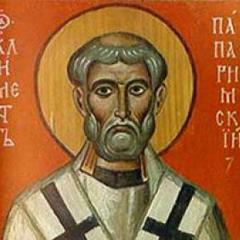
Pope Clement I
Pope Clement I

Limited information available. A detailed English biography of Pope Clement I cannot be provided. more

You May Also Like

“To Whom does our God say, 'in our image' (Gen. 1:26), to whom if it is not to Him who is 'the brightness of His glory and the express image of His Person' (Heb. 1:3), 'the image of the invisible God' (Col. 1:15)? It is then to His living image, to Him Who has said 'I and My Father are one' (Jn. 10:30), 'He who has seen Me has seen the Father' (Jn. 14:9), that God says, 'Let us make man in our image'.”

“Human life is but of brief duration. 'All flesh is grass, and all the goodliness thereof is as the flower of the field. The grass withers, the flower fades; but the word of our God shall stand forever' (Isa. 40:6, 8). Let us hold fast to the commandment that abides, and despise the unreality that passes away.”

“...[sacred] doctrine is especially based upon arguments from authority, inasmuch as its principles are obtained by revelation: thus we ought to believe on the authority of those to whom the revelation has been made. Nor does this take away from the dignity of this doctrine, for although the argument from authority based on human reason is the weakest, yet the argument from authority based on divine revelation is the strongest.”

“Sacred Scripture, since it has no science above itself, can dispute with one who denies its principles only if the opponent admits some at least of the truths obtained through divine revelation; thus we can argue with heretics from texts in Holy Writ, and against those who deny one article of faith we can argue from another. If our opponent believes nothing of divine revelation, there is no longer any means of proving the articles of faith by reasoning, but only of answering his objections - if he has any - against faith.”

“It may well happen that what is in itself the more certain on account of the weakness of our intelligence, which is dazzled by the clearest objects of nature; as the owl is dazzled by the light of the sun. Hence the fact that some happen to doubt about articles of faith is not due to the uncertain nature of the truths, but to the weakness of human intelligence; yet the slenderest knowledge that may be obtained of the highest things is more desirable than the most certain knowledge obtained of lesser things.”