“Man is a transitory being, and his designs must partake of the imperfections of their author. To confer duration is not always in our power. We must snatch the present moment, and employ it well, without too much solicitude for the future, and content ourselves with reflecting that our part is performed. He that waits for an opportunity to do much at once, may breathe out his life in idle wishes, and regret, in the last hour, his useless intentions and barren zeal.”
Quote by Samuel Johnson
Work
The Rambler: A Periodical Paper, Published in 1750, 1751, 1752
The Rambler is a series of periodical papers that were published in three separate volumes, spanning the years 1750, 1751, and 1752. Each volume consists of a variety of essays and articles, covering a range of topics including social issues, literature, and philosophy. The work is notable for its contribution to the development of the essay form and its influence on subsequent literary works. more
Author
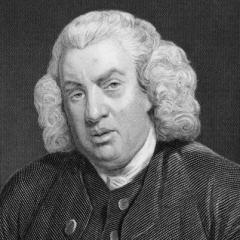
Samuel Johnson
Samuel Johnson was an English writer, poet, and lexicographer, renowned for his comprehensive English dictionary, 'A Dictionary of the English Language', published in 1755. His distinctive writing style and wit have cemented his place as a significant figure in the history of English literature. more
You May Also Like
Source: The Life and Writings of Samuel Johnson...
Source: Selected poetry and prose
Source: The Works of Samuel Johnson, LL.D.: With Murphy's Essay
Source: The Works of Samuel Johnson, LL.D.: With An Essay on His Life and Genius
Source: The works of Samuel Johnson, LL.D.: Together with his life, and notes on his Lives of the poets, by Sir John Hawkins, Knt. In eleven volumes ...
Source: The Works of Samuel Johnson, LL.D..: The Rambler
Source: The Rambler: In Four Volumes..
“I love doing logos. I've been a graphic artist all my life.”
“Faults and defects every work of man must have.”
Source: Paradise lost
“All envy would be extinguished, if it were universally known that there are none to be envied.”
Source: The Works of Samuel Johnson...