Quotessence
Home / Quotes / Quote by Friedrich Engels

Quote by Friedrich Engels

Author

Friedrich Engels
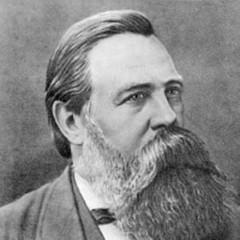
Friedrich Engels

Friedrich Engels was a German philosopher, politician, economist, and revolutionary, co-founder of communist theory with Karl Marx. He was born on November 28, 1820, and died on August 5, 1895. more

You May Also Like

“In your letter you apply the word imponderable to a molecule. Don't do that again. It may also be worth knowing that the aether cannot be molecular. If it were, it would be a gas, and a pint of it would have the same properties as regards heat, etc., as a pint of air, except that it would not be so heavy.”

“Take an arrow, and hold it in flame for the space of ten pulses, and when it cometh forth you shall find those parts of the arrow which were on the outsides of the flame more burned, blacked, and turned almost to coal, whereas the midst of the flame will be as if the fire had scarce touched it. This is an instance of great consequence for the discovery of the nature of flame; and sheweth manifestly, that flame burneth more violently towards the sides than in the midst.”

“That there is a Spring, or Elastical power in the Air we live in. By which ελατνρ [elater] or Spring of the Air, that which I mean is this: That our Air either consists of, or at least abounds with, parts of such a nature, that in case they be bent or compress'd by the weight of the incumbent part of the Atmosphere, or by any other Body, they do endeavour, as much as in them lies, to free themselves from that pressure, by bearing against the contiguous Bodies that keep them bent.”

“[1.] And first I suppose that there is diffused through all places an aethereal substance capable of contraction & dilatation, strongly elastick, & in a word, much like air in all respects, but far more subtile. 2. I suppose this aether pervades all gross bodies, but yet so as to stand rarer in their pores then in free spaces, & so much ye rarer as their pores are less ... 3. I suppose ye rarer aether within bodies & ye denser without them, not to be terminated in a mathematical superficies, but to grow gradually into one another.”

“I don't think America can just drill itself out of its current energy situation. We don't need to destroy the environment to meet our energy needs. We need smart, comprehensive, common-sense approaches that balance the need to increase domestic energy supplies with the need to maximize energy efficiency.”