Quotessence
Home / Quotes / Quote by Franklin D. Roosevelt

Quote by Franklin D. Roosevelt

“The test of our progress is not whether we add more to the abundance of those who have much; it is whether we provide enough for those who have too little.”

Quote by Franklin D. Roosevelt

Author
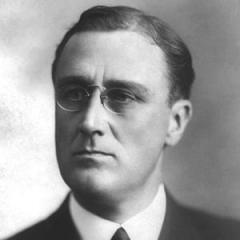
Franklin D. Roosevelt

Franklin D. Roosevelt was the 32nd President of the United States, serving for 12 years, the longest tenure in U.S. history. He led the nation through the Great Depression and World War II, implementing a series of reform measures known as the New Deal. more

You May Also Like

“It was possible, no doubt, to imagine a society in which wealth, in the sense of personal possessions and luxuries, should be evenly distributed, while power remained in the hands of a small privileged caste. But in practice such a society could not long remain stable. For if leisure and security were enjoyed by all alike, the great mass of human beings who are normally stupefied by poverty would become literate and would learn to think for themselves; and when once they had done this, they would sooner or later realise that the privileged minority had no function, and they would sweep it away. In the long run, a hierarchical society was only possible on a basis of poverty and ignorance.”

“Close your eyes, Maxon." "What?" "Close your eyes. Somewhere in this palace, there is a woman who will be your wife. This girl? Imagine that she depends on you. She needs you to cherish her and make her feel like the Selection didn't even happen. Like if you were dropped in your own out in the middle of the country to wander around door to door, she's still the one you would have found. She was always the one you would have picked. She needs you to provide for her and protect her. And if it came to a point where there was absolutely nothing to eat, and you couldn't even fall asleep at night because the sound of her stomach growling kept you awake—" "Stop it!" "Sorry." "Is that really what it's like? Out there... does that happen? Are people hungry like that a lot?" "Maxon, I..." "Tell me the truth." "Yes. That happens. I know of families where people give up their share for their children or siblings. I know of a boy who was whipped in the town square for stealing food. Sometimes you do crazy things when you are desperate." "A boy? How old?" "Nine." "Have you ever been like that? Starving?...How bad?" "Maxon, it will only upset you more." "Probably, but I'm only starting to realize how much I don't know about my own country. Please." "We've been pretty bad. Most time if it gets to where we have to choose, we keep the food and lose electricity. The worst was when it happened near Christmas one year. May didn't understand why we couldn't exchange gifts. As a general rule, there are never any leftovers at my house. Someone always wants more. I know the checks we've gotten over the last few weeks have really helped, and my family is really smart about money. I'm sure they have already tucked it away so it will stretch out for a long time. You've done so much for us, Maxon." "Good God. When you said that you were only here for the food, you weren't kidding, were you?" "Really, Maxon, we've been doing pretty well lately. I—" "I'll see you at dinner.”

“I am convinced that imprisonment is a way of pretending to solve the problem of crime. It does nothing for the victims of crime, but perpetuates the idea of retribution, thus maintaining the endless cycle of violence in our culture. It is a cruel and useless substitute for the elimination of those conditions--poverty, unemployment, homelessness, desperation, racism, greed--which are at the root of most punished crime. The crimes of the rich and powerful go mostly unpunished. It must surely be a tribute to the resilience of the human spirit that even a small number of those men and women in the hell of the prison system survive it and hold on to their humanity.”

“This is the thing: If you have the option to not think about or even consider history, whether you learned it right or not, or whether it even deserves consideration, that’s how you know you’re on board the ship that serves hors d’oeuvres and fluffs your pillows, while others are out at sea, swimming or drowning, or clinging to little inflatable rafts that they have to take turns keeping inflated, people short of breath, who’ve never even heard of the words hors d’oeuvres or fluff. Then someone from up on the yacht says, "It's too bad those people down there are lazy, and not as smart and able as we are up here, we who have built these strong, large, stylish boats ourselves, we who float the seven seas like kings." And then someone else on board says something like, "But your father gave you this yacht, and these are his servants who brought the hors d'oeuvres." At which point that person gets tossed overboard by a group of hired thugs who'd been hired by the father who owned the yacht, hired for the express purpose of removing any and all agitators on the yacht to keep them from making unnecessary waves, or even referencing the father or the yacht itself. Meanwhile, the man thrown overboard begs for his life, and the people on the small inflatable rafts can't get to him soon enough, or they don't even try, and the yacht's speed and weight cause an undertow. Then in whispers, while the agitator gets sucked under the yacht, private agreements are made, precautions are measured out, and everyone quietly agrees to keep on quietly agreeing to the implied rule of law and to not think about what just happened. Soon, the father, who put these things in place, is only spoken of in the form of lore, stories told to children at night, under the stars, at which point there are suddenly several fathers, noble, wise forefathers. And the boat sails on unfettered.”

“American humorist Kin Hubbard said , "It ain't no disgrace to be poor, but it might as well be". The meanest eating or drinking establishment, owned by a man who is himself poor, is very likely to have a sign on its wall asking this cruel question: "If you're so smart, why ain't you rich?" Americans, like human beings everywhere, believe many things that are obviously untrue... Their most destructive untruth is that it is very easy for any American to make money. They will not acknowledge how in fact hard money is to come by, and, therefore, those who have no money blame and blame and blame themselves. This inward blame has been a treasure for the rich and powerful, who have had to do less for their poor, publicly and privately, than any other ruling class since, say, Napoleonic times. Many novelties have come from America. The most startling of these, a thing without precedent is a mass of undignified poor. They do not love one another because they do not love themselves.”

“Fear of the mob is a superstitious fear. It is based on the idea that there is some mysterious, fundamental difference between rich and poor, as though they were two different races, like Negroes and white men. But in reality there is no such difference. The mass of the rich and the poor are differentiated by their incomes and nothing else, and the average millionaire is only the average dishwasher dressed in a new suit. Change places, and handy dandy, which is the justice, which is the thief? Everyone who has mixed on equal terms with the poor knows this quite well. But the trouble is that intelligent, cultivated people, the very people who might be expected to have liberal opinions, never do mix with the poor. For what do the majority of educated people know about poverty?”