Quotessence
Home / Quotes / Quote by Albert Camus

Quote by Albert Camus

“To work and create “for nothing,” to sculpture in clay, to know that one’s creation has no future, to see one’s work destroyed in a day while being aware that fundamentally this has no more importance than building for centuries—this is the difficult wisdom that absurd thought sanctions. Performing these two tasks simultaneously, negating on the one hand and magnifying on the other, is the way open to the absurd creator. He must give the void its colors.”

Quote by Albert Camus

Work

The Myth of Sisyphus and Other Essays

This book is a compilation of essays that delve into the philosophical concepts of existentialism, focusing on the human experience and the meaning of life. It includes discussions on the nature of existence, the absurdity of life, and the role of individual freedom and responsibility. more

Author
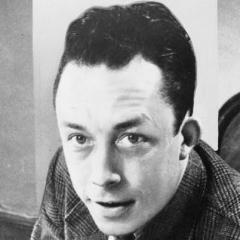
Albert Camus
Albert Camus

Albert Camus was a French author and philosopher, born on November 7, 1913, and died on January 4, 1960. Known for his unique existentialist philosophy and profound insights into human suffering, Camus' works include 'The Stranger', 'The Plague', and 'The Myth of Sisyphus', which have had a profound impact on 20th-century literature. more

You May Also Like

“No more quickly can a person rob you of your joy and peace than when that individual succeeds at making you feel like you're less than worthy of God as compared to his/her own self. The old adage "You're on your way to hell, and I'm on my way to heaven" spoken or implied to another, is the most predominantly effective way to make someone feel better about himself; and he doesn't even have to prove he's better in this life on earth because now he can just say "Wait 'til I'm looking down at you while you're in hell!" But don't be robbed of your joy and peace, individuals or groups of people like that don't know where God is; He is a whisper-distance away from you, is all.”

“Most striking about the traditional societies of the Congo was their remarkable artwork: baskets, mats, pottery, copper and ironwork, and, above all, woodcarving. It would be two decades before Europeans really noticed this art. Its discovery then had a strong influence on Braque, Matisse, and Picasso -- who subsequently kept African art objects in his studio until his death. Cubism was new only for Europeans, for it was partly inspired by specific pieces of African art, some of them from the Pende and Songye peoples, who live in the basin of the Kasai River, one of the Congo's major tributaries. It was easy to see the distinctive brilliance that so entranced Picasso and his colleagues at their first encounter with this art at an exhibit in Paris in 1907. In these central African sculptures some body parts are exaggerated, some shrunken; eyes project, cheeks sink, mouths disappear, torsos become elongated; eye sockets expand to cover almost the entire face; the human face and figure are broken apart and formed again in new ways and proportions that had previously lain beyond sight of traditional European realism. The art sprang from cultures that had, among other things, a looser sense than Islam or Christianity of the boundaries between our world and the next, as well as those between the world of humans and the world of beasts. Among the Bolia people of the Congo, for example, a king was chosen by a council of elders; by ancestors, who appeared to him in a dream; and finally by wild animals, who signaled their assent by roaring during a night when the royal candidate was left at a particular spot in the rain forest. Perhaps it was the fluidity of these boundaries that granted central Africa's artists a freedom those in Europe had not yet discovered.”

“The figure in the icon is not meant to represent literally what Peter or John or any of the apostles looked like, or what Mary looked like, nor the child, Jesus. But, the orthodox painter feels, Jesus of Nazareth did not walk around Galilee faceless. The icon of Jesus may not look like the man Jesus two thousand years ago, but it represents some *quality* of Jesus, or his mother, or his followers, and so becomes an open window through which we can be given a new glimpse of the love of God.”