Quotessence
Home / Quotes / Quote by John Maynard Keynes

Quote by John Maynard Keynes

Work

Thorstein Veblen, R.H. Tawney, John Maynard Keynes

The book includes essays and writings by Thorstein Veblen, known for his work on institutional economics and the theory of conspicuous consumption. R.H. Tawney contributes with his analysis of economic history and social issues. John Maynard Keynes is represented by his influential economic theories, particularly those related to macroeconomics and the role of government in economic stability. more

Author
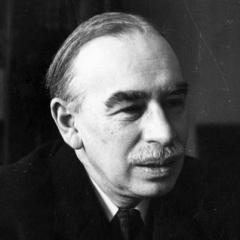
John Maynard Keynes
John Maynard Keynes

John Maynard Keynes, born on June 5, 1883, was a prominent British economist whose work had a profound impact on the field of economics, particularly in the area of macroeconomics. His theories advocating for government intervention to stabilize the economy gained widespread application during the Great Depression of the 1930s. more

You May Also Like

“Then came the second Amsterdam discovery, although the principle was known elsewhere. Bank deposits...did not need to be left idly in the bank. They could be lent. The bank then got interest. The borrower then had a deposit that he could spend. But the original deposit still stood to the credit of the original depositor. That too could be spent. Money, spendable money, had been created. Let no one rub his or her eyes. It's still being done-every day. The creation of money by a bank is as simple as this, so simple, I've often said, that the mind is slightly repelled.”

“A rentier is an investor whose relationship to a company or enterprise is strictly limited to the ownership of financial wealth (such as stocks or bonds) and the receipt of income on that wealth (such as dividends or interest). The financial system performs dismally at its advertised task, that of efficiently directing society's savings towards their optimal investment pursuits. The system is stupefyingly expensive, gives terrible signals for the allocation of capital, and has surprisingly little to do with real investment.”

“No politician can praise unemployment or inflation, and there is no way of combining high employment with stable prices that does not involve some control of income and prices. Otherwise the struggle for more consumption and more income to sustain it-a struggle that modern corporations, modern unions and modern democracy all facilitate and encourage-will drive up prices. Only heavy unemployment will then temper this upward thrust. Not many wish to confront the truth that the modern economy gives a choice only between inflation, unemployment, or controls.”

“Growth is the mantra of our society because the economy can't remain healthy without growth.Impregnable monopolies aside (and these are few), profits are both the hallmark of capitalism and its Achilles heel, for no business can permanently maintain its prices much above its costs. There is only one way in which profits can be perpetuated; a business-or an entire economy-must grow.”

“Capitalism is chronically unstable.Boom and bust has always marked capitalism in the United States. There were panics in 1785, 1791, 1819, 1857, 1869, 1873, 1907, 1929 and 1987.In economies and politics, as in war, an astonishing number of people die, like the man on the railway crossing, defending their right of way. This is a poorly developed instinct in Switzerland. No country so firmly avows the principles of private enterprise but in few have the practical concessions to socialism been more numerous and varied.”

“The ideal of a perfectly functioning democracy is one person, one vote; the ideal of a perfectly functioning market is one dollar, one vote.It's a hoary superstition that democratically elected governments invariably function as instruments of the collective will.A society in which consumption has to be artificially stimulated in order to keep production going is a society founded on trash and waste.”