Quotessence
Home / Quotes / Quote by Thales

Quote by Thales

“What man is happy? He who has a healthy body, a resourceful mind, and a docile nature.”

Quote by Thales

Author
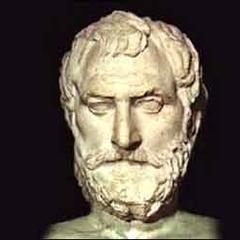
Thales
Thales

Thales, a renowned philosopher of ancient Greece, is considered one of the founders of Western philosophy. Born in 624 BC and died in 546 BC, Thales is known for his observations of natural phenomena and rational thinking. He posed many fundamental questions about the universe and nature, which had a profound impact on subsequent philosophers. more

You May Also Like

“Now, I stand alone on this rock, fighting the errors of this world, and establish the science of life by my works. What is my mode of warfare? With the axe of truth I strike at the root of every tree of error and hew it down, so that there shall not be one error in man showing itself in the form of disease.”

“Every one is made of matter, and matter is continually going through a chemical change. This change is life, not wisdom, but life, like vegetable or mineral life. Every idea is matter, so of course it contains life in the name of something that can be changed. Motion, or change, is life. Ideas have life. A belief has life, or matter; for it can be changed. Now, all the aforesaid make up man; and all this can be changed.”

“Disease is the misery of our belief, happiness is the health of our wisdom, so that man's happiness or misery depends on himself. Now, as our misery comes from our belief, and not from the thing believed, it is necessary to be on the watch, so as not to be deceived by false guides. Sensation contains no intelligence or belief, but is a mere disturbance of the matter, called agitation, which produces mind, and is ready to receive the seed of error. Ever since man was created, there has been an element called error which has been busy inventing answers for every sensation.”

“Man is made of opinions,—of truth and error; and his life is a warfare like all other lives before him.... Man goes on developing error upon error till he is buried in his own belief.... It is the office of wisdom to explain the phenomena in man called disease, to show how it is made, and how it can be unmade. This is as much a science as it is to know how to decompose a piece of metal.”