Quotessence
Home / Quotes / Quote by E. O. Wilson

Quote by E. O. Wilson

“The great paradox of determinism and free will, which has held the attention of the wisest of philosophers and psychologists for generations, can be phrased in more biological terms as follows: If our genes are inherited, and our environment is a train of physical events set in motion before we were born, how can there be a truly independent agent within the brain? The agent itself is created by the interaction of the genes and the environment. It would appear that our freedom is only a self delusion.”

Quote by E. O. Wilson

Author
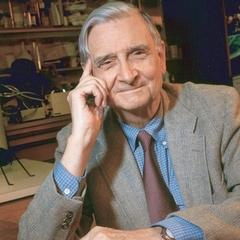
E. O. Wilson
E. O. Wilson

E. O. Wilson is a renowned American biologist, born on June 10, 1929. He has made significant contributions to the fields of entomology, sociobiology, and anthropology. Best known for his research on ants, he is often referred to as the 'father of ants'. His book 'Sociobiology: The New Science' had a profound impact on both biology and the social sciences. more

You May Also Like

“But nature - that is, biological evolution - has not fitted man to any specific environment. On the contrary, ... he has a rather crude survival kit; and yet -this is the paradox of the human condition - one that fits him to all environments. Among the multitude of animals which scamper, fly, burrow and swim around us, man is the only one who is not locked into his environment. His imagination, his reason, his emotional subtlety and toughness, make it possible for him not to accept the environment but to change it.”

“Our ancestors were eating meat over 2.5 million years ago. We mainly ate meat, fish, fruits, vegetables and nuts. We have to assume our physiology evolved in association with this diet. The balanced diet for our species was what we could acquire then, not what the government and doctors tell us to eat now.”

“A life that stood out as a gospel of self-forgetting service. He could have added fortune to fame but caring for neither he found happiness and honor in being helpful to the world. The centre of his world was the south where he was born in slavery some 79 years ago and where he did his work as a creative scientist.”

“When you are famous it is hard to work on small problems. This is what did [Claude Elwood] Shannon in. After information theory, what do you do for an encore? The great scientists often make this error. They fail to continue to plant the little acorns from which the mighty oak trees grow. They try to get the big thing right off. And that isn't the way things go. So that is another reason why you find that when you get early recognition it seems to sterilize you.”