Quotessence
Home / Quotes / Quote by George Orwell

Quote by George Orwell

“By 'nationalism' I mean first of all the habit of assuming that human beings can be classified like insects and that whole blocks of millions and tens of millions of people can be confidently labeled 'good' or 'bad'...By 'patriotism' I mean devotion to a particular place and a particular way of life, which one believes to be best in the world but has no wish to force on other people. Patriotism is of its nature defensive, both militarily and culturally. Nationalism, on the other hand, is inseparable from the desire for power.”

Quote by George Orwell

Author
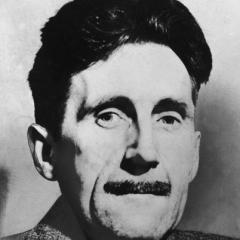
George Orwell
George Orwell

George Orwell, born Eric Arthur Blair, was a British novelist and political critic. Known for his sharp social criticism and profound insights into totalitarianism, Orwell is best remembered for his novels '1984' and 'Animal Farm', which remain influential to this day. more

You May Also Like

“A dreaded society is not a civilized society. The most progressive and powerful society in the civilized sense, is a society which has recognized its ethos, and come to terms with the past and the present, with religion and science. With modernism and mysticism, with materialism and spirituality; a society free of tension, a society rich in culture. Such a society cannot come with hocus-pocus formulas and with fraud. It has to flow from the depth of a divine search.”

“The prevailing tendency to regard all the marked distinctions of human character as innate, and in the main indelible, and to ignore the irresistible proofs that by far the greater part of those differences, whether between individuals, races, or sexes are such as not only might but naturally would be produced by differences in circumstances, is one of the chief hinderances to the rational treatment of great social questions, and one of the greatest stumbling blocks to human improvement.”

“Many are really virtuous who cannot explain what virtue is . . . But the powers themselves in reality perform their several operations with sufficient constancy and uniformity in persons of good health whatever their opinions be about them . . .”

“Mr. J.S. Mill speaks, in his celebrated work, "Utilitarianism," of the social feelings as a "powerful natural sentiment," and as "the natural basis of sentiment for utilitarian morality," but on the previous page he says, "if, as is my own belief, the moral feelings are not innate, but acquired, they are not for that reason less natural." It is with hesitation that I venture to differ from so profound a thinker, but it can hardly be disputed that the social feelings are instinctive or innate in the lower animals; and why should they not be so in man?”