Quotessence
Home / Quotes / Quote by John Dewey

Quote by John Dewey

Work

The Later Works, 1925-1953: 1938-1939

The volume includes a selection of essays, stories, and other writings that reflect the author's continued exploration of themes and ideas during the specified time frame. more

Author
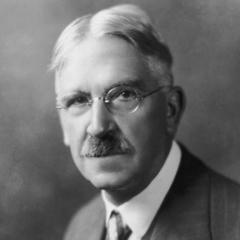
John Dewey
John Dewey

John Dewey was an American philosopher and educator, born on October 20, 1859, and died on June 1, 1952. He was a leading figure in the philosophy of pragmatism and had a profound impact on 20th-century education, philosophy, and the social sciences. more

You May Also Like

“While [Plato] affirmed with emphasis that the place of the individual in society should not be determined by birth or wealth or any conventional status, but by his own nature as discovered in the process of education, he had no perception of the uniqueness of individuals. For him they fall by nature into classes, and into a very small number of classes at that.”

“But progress in knowledge has made us aware of the superficiality of Plato's lumping of individuals and their original powers into a few sharply marked-off classes; it has taught us that original capacities are indefinitely numerous and variable. It is but the other side of this fact to say that in the degree in which society has become democratic, social organization means utilization of the specific and variable qualities of individuals, not stratification by classes.”

“The breakdown of Plato's philosophy is made apparent in the fact that he could not trust to gradual improvements in education to bring about a better society which should then improve education, and so on indefinitely. Correct education could not come into existence until an ideal state existed, and after that education would be devoted simply to its conservation. For the existence of this state he was obliged to trust to some happy accident by which philosophic wisdom should happen to coincide with possession of ruling power in the state.”

“To oscillate between drill exercises that strive to attain efficiency in outward doing without the use of intelligence, and an accumulation of knowledge that is supposed to be an ultimate end in itself, means that education accepts the present social conditions as final, and thereby takes upon itself the responsibility for perpetuating them. A reorganization of education so that learning takes place in connection with the intelligent carrying forward of purposeful activities is a slow work. It can be accomplished only piecemeal, a step at a time.”

“The imagination is the medium of appreciation in every field. The engagement of the imagination is the only thing that makes any activity more than mechanical. Unfortunately, it is too customary to identify the imaginative with the imaginary, rather than with a warm and intimate taking in of the full scope of a situation.”