“My own view on religion is that of Lucretius. I regard it as a disease born of fear and as a source of untold misery to the human race. I cannot, however, deny that it has made some contributions to civilisation. It helped in early days to fix the calendar, and it caused Egyptian priests to chronicle eclipses with such care that in time they became able to predict them. These two services I am prepared to acknowledge, but I do not know of any others.”
Quote by Bertrand Russell
Work
A Fresh Look at Empiricism: 1927-42
A comprehensive examination of the evolution of empiricism from 1927 to 1942, the book delves into the key figures, theories, and debates that shaped this intellectual landscape. more
Author
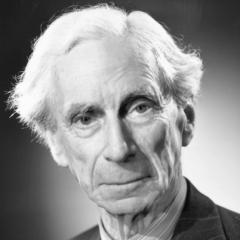
Bertrand Russell
Bertrand Russell was a British philosopher, mathematician, and logician born on May 18, 1872, and died on February 2, 1970. He is known for his contributions to logic and mathematics, particularly in the fields of mathematical logic and philosophical analysis. His works spanned a wide range of subjects, including ethics, political philosophy, history, and literary criticism. more
You May Also Like
“My whole religion is this: do every duty, and expect no reward for it, either here or hereafter.”
Source: Bertrand Russell on God and Religion
Source: The Basic Writings of Bertrand Russell
Source: Sceptical Essays
Source: Why I Am Not a Christian: And Other Essays on Religion and Related Subjects
Source: Bertrand Russell on God and Religion
Source: The basic writings of Bertrand Russell, 1903-1959
Source: Why I Am Not a Christian: And Other Essays on Religion and Related Subjects
“Every action of our lives touches on some chord that will vibrate in eternity.”