Quotessence
Home / Quotes / Quote by Franz Kafka

Quote by Franz Kafka

Work

The castle

This book delves into the lives of individuals within a remote castle, examining the absurdities and complexities of an oppressive administrative system. It is renowned for its philosophical depth and intricate narrative structure. more
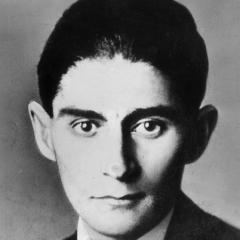
Author

Franz Kafka
Franz Kafka

Franz Kafka (July 3, 1883 - June 3, 1924) was an important German-language novelist of the 20th century, known for his unique literary style and profound philosophical thoughts. His works, often themed around loneliness, alienation, and existentialism, have had a profound impact on literature and philosophy. more

You May Also Like

“The thought that you will become a master in something after the first attempt is neither here nor there. You don't get master's degree by attending school on the first day of your life! Time will tell, so you got to persist!”

“Rome has been called the "Sacred City": - might not our Oxford be called so too? There is an air about it, resonant of joy and hope: it speaks with a thousand tongues to the heart: it waves its mighty shadow over the imagination: it stands in lowly sublimity, on the "hill of ages"; and points with prophetic fingers to the sky: it greets the eager gaze from afar, "with glistering spires and pinnacles adorned," that shine with an internal light as with the lustre of setting suns; and a dream and a glory hover round its head, as the spirits of former times, a throng of intellectual shapes, are seen retreating or advancing to the eye of memory: its streets are paved with the names of learning that can never wear out: its green quadrangles breathe the silence of thought.”

“...reality is a system, completely ordered and fully intelligible, with which thought in its advance is more and more identifying itself. We may look at the growth of knowledge … as an attempt by our mind to return to union with things as they are in their ordered wholeness…. and if we take this view, our notion of truth is marked out for us. Truth is the approximation of thought to reality … Its measure is the distance thought has travelled … toward that intelligible system … The degree of truth of a particular proposition is to be judged in the first instance by its coherence with experience as a whole, ultimately by its coherence with that further whole, all comprehensive and fully articulated, in which thought can come to rest.”

“A cultivated mind—I do not mean that of a philosopher, but any mind to which the fountains of knowledge have been opened, and which has been taught, in any tolerable degree, to exercise its faculties—finds sources of inexhaustible interest in all that surrounds it: in the objects of nature, the achievements of art, the imaginations of poetry, the incidents of history, the ways of mankind, past and present, and their prospects in the future.”