Quotessence
Home / Quotes / Quote by Ayn Rand

Quote by Ayn Rand

Work

The Return of the Primitive: The Anti-Industrial Revolution

This book delves into the arguments against industrialization, examining its effects on traditional lifestyles and the natural world, and advocating for a return to more primitive ways of living. more

Author
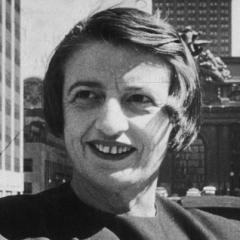
Ayn Rand
Ayn Rand

American novelist and philosopher, known for her novels and philosophical ideas. Her works emphasize individualism, free markets, and rationalism, and have had a profound impact on politics and philosophy in the late 20th century. more

You May Also Like

“Is this a textbook case of bad faith, of lying self-deception combined with outrageous stupidity? Or is it simply the case of the eternally unrepentant criminal (Dostoevski once mentions in his diaries that in Siberia, among scores of murderers, rapists, and burglars, he never met a single man who would admit that he had done wrong) who cannot afford to face reality because his crime has become part and parcel of it? (...) During the war, the lie most effective with the whole of the German people was the slogan of “the battle destiny for the German people” [der Schicksalskampf des deutschen Volkes], coined either by Hitler or by Goebbels, which made self-deception easier on three counts: it suggested, first, that the war was no war; second, that it was started by destiny and not by Germany; and third, that it was a matter of life and death for the Germans, who must annihilate their enemies or be annihilated.”

“For us, then, life is a confidence trick we must run on ourselves, hoping we do not catch on to any monkey business that would leave us stripped of our defense mechanisms and standing stark naked before the silent, staring void. To end this self-deception, to free our species of the paradoxical imperative to be and not to be conscious, our backs breaking by degrees upon a wheel of lies, we must cease reproducing. Nothing less will do.”

“Human nature is full of riddles and contradictions; its very complexity engenders art—and by art I mean the search for something more than simple linear formulations, flat solutions, oversimplified explanations. One of these riddles is: how is it that people who have been crushed by the sheer weight of slavery and cast to the bottom of the pit can nevertheless find strength to rise up and free themselves, first in spirit and then in body; while those who soar unhampered over the peaks of freedom suddenly appear to lose the taste for freedom, lose the will to defend it, and, hopelessly confused and lost, almost begin to crave slavery. Or again: why is it that societies which have been benumbed for half a century by lies they have been forced to swallow find within themselves a certain lucidity of heart and soul which enables them to see things in their true perspective and to perceive the real meaning of events; whereas societies with access to every kind of information suddenly plunge into lethargy, into a kind of mass blindness, a kind of voluntary self deception.”

“The instinct of self-deception in human beings makes them try to banish from their minds dangers of which at the bottom they are perfectly aware by declaring them nonexistent, and a warning such as mine against cheap optimism was bound to prove particularly unwelcome at a moment when a sumptuously laid supper was awaiting for us in the next room.”

“Find out what faith is and how you can put it into practice. Learn how to pray, and do it. Discover what pride is, and get rid of it. Develop a self-concept that is adequate and accurate. Clarify your values. Identify your talents. Probe the fact, meaning, and use of your sexuality. Face the fact that you engage in self-deception. Reflect on truth that you are made in the image of God. Use your spiritual gift. Clear your conscience. Feel deeply. Enjoy life. Face death. Treat your body right. Conquer the flesh. Depend on the Holy Spirit. Be humble.”