“That is why the second coming of the Lord is not only salvation, not only the omega that sets everything right, but also judgment. Indeed at this stage we can actually define the meaning of the talk of judgment. It means precisely this, that the final stage of the world is not the result of a natural current but the result of responsibility that is grounded in freedom. This must be regarded as the key to understanding why the New Testament clings fast, in spite of its message of grace, to the assertion that at the end men are judged "by their works" and that no one can escape giving an account of the way he has lived his life. There is a freedom that is not cancelled out even by grace and, indeed, is brought by it face to face with itself: man's final fate is not forced upon him regardless of the decisions he has made in his life. This assertion is in any case also necessary in order to draw the line between faith and false dogmatism or a false Christian self-confidence. This line alone confirms the equality of men by confirming the identity of their responsibility. ... Perhaps in the last analysis it is impossible to escape a paradox whose logic is completely disclosed only to the experience of a life based on faith. Anyone who entrusts himself to a life of faith becomes aware that both exist: the radical character of grace that frees helpless man and,no less, the abiding seriousness of the responsibility that summons man day after day. Both together mean that the Christian enjoys, on the one hand, the liberating, detached tranquility of him who lives on that excess of divine justice known as Jesus Christ. ... This is the source of a profound freedom, a knowledge of God's unrepentant love; he sees through all our errors and remains well disposed to us. ... At the same time, the Christian knows, however, that he is not free to do whatever he pleases, that his activity is not a game that God allows him and does not take seriously. He knows that he must answer for his actions, that he owes an account as a steward of what has been entrusted to him. There can only be responsibility where there is someone to be responsible to, someone to put the questions. Faith in the Last Judgment holds this questioning of our life over our heads so that we cannot forget it for a moment. Nothing and no one empowers us to trivialize the tremendous seriousness involved in such knowledge; it shows our life to be a serious business and precisely by doing so gives it its dignity.”
Quote by Pope Benedict XVI
Work
This book serves as a comprehensive guide to the core principles and historical context of Christianity, exploring its origins, key figures, and theological concepts. more
Author
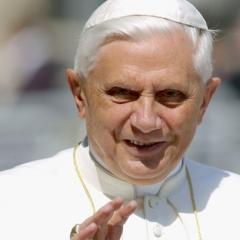
Pope Benedict XVI, born Joseph Aloisius Ratzinger, was the 265th Pope of the Roman Catholic Church, serving from 2005 to 2013. He had a deep academic background in philosophy and theology, serving as a Cardinal and President of the Pontifical Biblical Commission. During his papacy, Pope Benedict XVI worked to promote church reform and dialogue, emphasizing the importance of traditional doctrine while balancing conservative and reformist forces within the church. more
You May Also Like
“Every life matters. Be like Mother Nature and love everyone without judging.”
“Everyone has a past, and everyone's past matters.”