Quotessence
Home / Quotes / Quote by Karl Marx

Quote by Karl Marx

“We have thus seen that even the most favorable situation for the working class, namely, the most rapid growth of capital, however much it may improve the material life of the worker, does not abolish the antagonism between his interests and the interests of the capitalist. Profit and wages remain as before, in inverse proportion.”

Quote by Karl Marx

Work

Wage-Labour and Capital & Value, Price and Profit

Browse quotes and source details for this work. more

Author
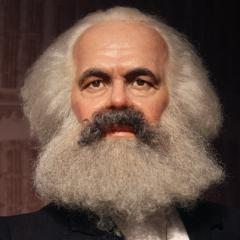
Karl Marx
Karl Marx

Karl Marx (May 5, 1818 - March 14, 1883) was a German philosopher, economist, sociologist, political theorist, and revolutionary. He is one of the founders of Marxism and his works, including 'Das Kapital' and 'The Communist Manifesto', have had a profound impact on the world. more

You May Also Like

“For what is socialism? With the frills removed, it is people collectively running society. Instead of being the prisoners of anarchic capitalist competition and the mad rush for profit at any cost, it is working together for the common good. Our tremendous co-operative power would be controlled, not by a ruling class in the search for ever greater profits, but democratically and for the fulfillment of human need.”

“I have had so many Dwellings, Nat, that I know these Streets as well as a strowling Beggar: I was born in this Nest of Death and Contagion and now, as they say, I have learned to feather it. When first I was with Sir Chris. I found lodgings in Phenix Street off Hogg Lane, close by St Giles and Tottenham Fields, and then in later times I was lodged at the corner of Queen Street and Thames Street, next to the Blew Posts in Cheapside. (It is still there, said Nat stirring up from his Seat, I have passed it!) In the time before the Fire, Nat, most of the buildings in London were made of timber and plaister, and stones were so cheap that a man might have a cart-load of them for six-pence or seven-pence; but now, like the Aegyptians, we are all for Stone. (And Nat broke in, I am for Stone!) The common sort of People gawp at the prodigious Rate of Building and exclaim to each other London is now another City or that House was not there Yesterday or the Situacion of the Streets is quite Changd (I contemn them when they say such things! Nat adds). But this Capital City of the World of Affliction is still the Capitol of Darknesse, or the Dungeon of Man's Desires: still in the Centre are no proper Streets nor Houses but a Wilderness of dirty rotten Sheds, allways tumbling or takeing Fire, with winding crooked passages, lakes of Mire and rills of stinking Mud, as befits the smokey grove of Moloch. (I have heard of that Gentleman, says Nat all a quiver). It is true that in what we call the Out-parts there are numberless ranges of new Buildings: in my old Black-Eagle Street, Nat, tenements have been rais'd and where my Mother and Father stared without understanding at their Destroyer (Death! he cryed) new-built Chambers swarm with life. But what a Chaos and Confusion is there: meer fields of Grass give way to crooked Passages and quiet Lanes to smoking Factors, and these new Houses, commonly built by the London workmen, are often burning and frequently tumbling down (I saw one, says he, I saw one tumbling!). Thus London grows more Monstrous, Straggling and out of all Shape: in this Hive of Noise and Ignorance, Nat, we are tyed to the World as to a sensible Carcasse and as we cross the stinking Body we call out What News? or What's a clock? And thus do I pass my Days a stranger to mankind. I'll not be a Stander-by, but you will not see me pass among them in the World. (You will disquiet your self, Master, says Nat coming towards me). And what a World is it, of Tricking and Bartering, Buying and Selling, Borrowing and Lending, Paying and Receiving; when I walk among the Piss and Sir-reverence of the Streets I hear, Money makes the old Wife trot, Money makes the Mare to go (and Nat adds, What Words won't do, Gold will). What is their God but shineing Dirt and to sing its Devotions come the Westminster-Hall-whores, the Charing-cross whores, the Whitehall whores, the Channel-row whores, the Strand whores, the Fleet Street whores, the Temple-bar whores; and they are followed in the same Catch by the Riband weavers, the Silver-lace makers, the Upholsterers, the Cabinet-makers, Watermen, Carmen, Porters, Plaisterers, Lightemen, Footmen, Shopkeepers, Journey-men... and my Voice grew faint through the Curtain of my Pain.”

“But this city is a world of its own, a country within a country. People are used to taking the old and making it news; and used, too, to taking the new and making it old. Every glass of water from its taps, it is said, has passed six times through the kidneys of another, and every scrap of its land has been trodden on, fought over, dug up and broken down for centuries.”

“Never forget,' says Sugar Daddy, 'we are a nation built on sugar. It is our history and it is the source of our prosperity, now and in the future.' This is true. Our entire nation sits on reclaimed land made from sugar. Ours is an island that rose out of the sea, built on a hard core of toffee.”