Quotessence
Home / Quotes / Quote by Allegra Goodman

Quote by Allegra Goodman

“There were three wedding cakes, curious and historical but tasty, each labeled with a calligraphed card: "Plumb Cake" with currants, nutmeg, mace, cinnamon, salt, citron, orange peel candied, flour, eggs, yeast, wine, cream, raisins. Adapted from Mrs. Simmons, American Cookery, 1796. "Curran-cake" with sugar, eggs, butter, flour, currans, brandy. Adapted from Mrs. McClintock, Receipts for Cookery and Pastry-Work, 1736. "Chocolate Honeycake" with oil, unsweetened cocoa and baking chocolate, honey, eggs, vanilla, flour, salt, baking powder. Adapted from Mollie Katzen, The Enchanted Broccoli Forest, 1982.”

Quote by Allegra Goodman

Work

The Cookbook Collector

This book explores the life of an individual deeply fascinated by the culinary history encapsulated in vintage cookbooks. The story delves into the collector's personal journey, intertwining his obsession with the art of cooking and the stories behind each book he acquires. more

Author
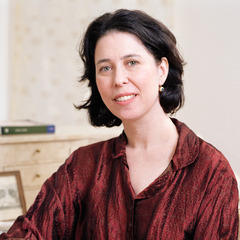
Allegra Goodman
Allegra Goodman

Allegra Goodman is an American author born in 1967. Her works span various literary genres, including novels, short story collections, and children's literature. Goodman's writing often explores moral dilemmas, social justice, and the complexities of human behavior. more

You May Also Like

“It's evident which drawing came from which mind," Johnny said with a small grin, and certainly, the pâte de verre flowers and spiraling tiers of Sylvie's cake said "Sugar Fair" as distinctly as the clean lines and elegant piping pointed to De Vere's. "But..." But at the essential level, the cakes were remarkably similar. They had both chosen a stained-glass effect, constructed entirely from blown sugar, each tier designed to catch the light and cast a shimmering cascade of color. Peony poppies, primroses, and petunias glittered within the sugar glass. And on the highest tier, the Midnight Elixir cake, they had both incorporated a trinity knot.”

“We'd better get out of here fast," Nadia says, "before anyone notices." "Or before our conman friend wakes up," Autumn says. "I doubt Mr. John Smith will be overjoyed when he wakes up and I, for one, would rather not be around to witness it. I also lifted his mobile phone and his wallet," I tell them with a certain amount of pride. "Hopefully, it means that he won't be able to contact you again, Chantal." "Is his driver's license in his wallet?" I flick through the pockets until I found it. "Yes. His real name is Felix Levare." "Could be another alias." Chantal takes it from me. "But I'll keep that as a little extra insurance anyway," she says. There's a wad of cash in the wallet which I help myself to. "This can all go to a deserving charity," I say, then throw the wallet and the mobile phone into the lake after his car. They also splash satisfyingly and then sink without trace. I press the money into Autumn's hands. "Take it and buy some chocolate for your druggie kids." She takes the cash and pockets it. "Thanks.”

“Bureaucracies, I've suggested, are not themselves forms of stupidity so much as they are ways of organizing stupidity--of managing relationships that are already characterized by extremely unequal structures of imagination, which exist because of the existence of structural violence.”

“Power makes you lazy. Insofar as our earlier theoretical discussion of structural violence revealed anything, it was this: that while those in situations of power and privilege often feel it as a terrible burden of responsibility, in most ways, most of the time, power is all about what you don't have to worry about, don't have to know about, and don't have to do.”

“The corporatization of U.S. agriculture and the growth of international free markets squeeze growers such that they cannot easily imagine increasing the pay of the pickers or improving the labor camps without bankrupting the farm. In other words, many of the most powerful inputs into the suffering of farmworkers are structural, not willed by individual agents. In this case, structural violence is enacted by market rule and later channeled by international and domestic racism, classism, sexism, and anti-immigrant prejudice. However, structural violence is not just a simple, unidirectional phenomenon; rather, macro social and economic structures produce vulnerability at every level of the farm hierarchy.”

“By structural violence, I mean the violence committed by configurations of social inequalities that, in the end, has injurious effects on bodies similar to the violence of a stabbing or shooting. This is what the English working men described by Friedrich Engels called 'social murder'. Much of the structural violence is organized along the fault lines of class, race, citizenship, gender, and sexuality. (...) Symbolic violence works through the perceptions of the 'dominating' and the 'dominated' (in Bourdieu's words), while it tends to benefit those with more power. each group understands not only itself but also the other to belong naturally in their positions in the social hierarchy. (...) Structural violence - with its pernicious effects on health - and symbolic violence - with its subtle naturalization of inequalities on the farm, in the clinic, and in the media - form the nexus of violence and suffering through which the phenomenon of migrant labor in North America is produced.”