Quotessence
Home / Quotes / Quote by Thomas Jefferson

Quote by Thomas Jefferson

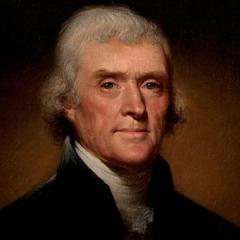
“The executive power in our government is not the only, perhaps not even the principal, object of my solicitude. The tyranny of the legislature is really the danger most to be feared, and will continue to be so for many years to come. The tyranny of the executive power will come in its turn, but at a more distant period.”

Quote by Thomas Jefferson

Work

Democracy in America

Published in the 19th century, this seminal work offers a detailed examination of the American political system, its history, and its societal implications. The author delves into the functioning of democracy, the role of the government, and the cultural fabric of the nation. more

Author

Thomas Jefferson
Thomas Jefferson

Thomas Jefferson was the third President of the United States, a distinguished politician, philosopher, architect, and scientist. He was born on April 13, 1743, and died on July 4, 1826. Jefferson advocated for democracy and freedom in politics and was one of the main authors of the Declaration of Independence. His political ideas had a profound impact on the founding and development of the United States. more

You May Also Like

“If men were angels, no government would be necessary. If angels were to govern men, neither external nor internal controls on government would be necessary. In framing a government which is to be administered by men over men, the great difficulty lies in this: you must first enable the government to control the governed; and in the next place oblige it to control itself.”

“The fundamental idea is that through the separation of powers and checks and balances, different voices—those of the President, the Senate, and the House of Representatives—can be expected to contribute to public debate about the ends and means of national policy. The notions are familiar: the President speaks as the nationally elected voice of the people generally; the Senate represents the states; and the House represents particular constituencies that often have highly local concerns. More generally, the President speaks for the nation, and members of Congress—while being concerned with matters of national import—speak especially for different constituent parts of the nation. This constitutional structure guarantees that diverse perspectives will contribute to dialogue about public policy.”

“Given the religious nature of the Middle Eastern culture, how might a Middle Eastern democracy [be] structured? Will there be three or four branches of government? Should a religious branch be added to the executive, legislative and judicial branches to ensure that Islamic beliefs and law are followed? A simple answer might be yes, but that is probably not the best means. Ideally, the legislative, executive and judicial bodies should all take Islamic beliefs into consideration when carrying out their duties. As such, there should be no need for a separate religious branch. However, to codify the major tenets of the Islamic faith, they should be represented in the constitution or similar document. This does not mean a theocracy will be established, rather it means that a democracy will be established built upon Islamic beliefs.”

“In turning now to the principle of dialogue underlying the Constitution's structure, it is important first to note a basic distinction. The Constitution's structural theory rests on two closely related but nevertheless separate principles: separation of powers and checks and balances. The first principle requires that the branches of government be identifiably discrete. The second assumes that the branches are separate and then concentrates on promoting the checking of each by the others. The task of separation summons forth a "formalist" analysis; it requires formal definitions of some sort to provide the baseline for analysis. The task of checking and balancing is most closely associated with a "functionalist" approach; it requires an awareness of the need to balance the roles and functions of different institutions in determining their appropriate relations.”

“Making wine and drinking wine is not new to African Americans and others in the Diaspora. South Africa has a three-century history in growing, harvesting and distilling grapes as wine. The entire continent of Africa has a history in wine-making. In this country, slaves cultivated the vineyards owned by Thomas Jefferson and other vintners.”

“Помнеше от прадеди, че докато виното кипи в бъчвата, то в избата трябва да има негасена вар. Никой не знаеше как негасената вар и кипящото вино общуват помежду си, но когато виното спираше да кипи, то негасената вар се разсипваше на ситен прах и посивяваше.”