Quotessence
Home / Quotes / Quote by Rosa Luxemburg

Quote by Rosa Luxemburg

Work

Leninism Or Marxism?

Browse quotes and source details for this work. more
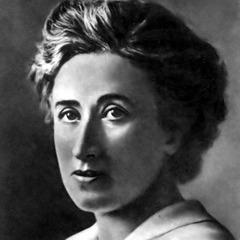
Author

Rosa Luxemburg
Rosa Luxemburg

Rosa Luxemburg (March 5, 1871 – January 15, 1919) was a Polish-German Marxist philosopher, economist, and revolutionary. She was a key figure in the German Social Democratic Party and a co-founder of the Communist Party of Germany. Known for her critique of capitalism, theory of imperialism, and advocacy for socialist democracy, she opposed World War I and was imprisoned for her anti-war activities. Luxemburg was murdered by right-wing paramilitaries during the German Revolution of 1919. Her works, including 'The Accumulation of Capital' and 'The Russian Revolution,' remain influential in Marxist theory. more

You May Also Like

“No word in the B vocabulary was ideologically neutral. A great many were euphemisms. Such words, for instance, as JOYCAMP (forced-labour camp) or MINIPAX Minis- try of Peace, i.e. Ministry of War) meant almost the exact opposite of what they appeared to mean. Some words, on the other hand, displayed a frank and contemptuous un- derstanding of the real nature of Oceanic society. An example was PROLEFEED, meaning the rubbishy enter- tainment and spurious news which the Party handed out to the masses.”

“The proletariat should not be viewed as a monolithic entity represented by a single party (a la the various currents of Marxism) but rather as a contested body whose unity is contingent on the freedom of its different parts to fight for their interests within it. The fight for women’s liberation or the recognition of the rights of various ethnic groups then are not battles to be put off until after the proletariat seizes power globally, but are necessary precursors to that seizure of power that clarify the revolutionary orientation of the proletariat.”

“El desempleo, para el que no había seguro, era el mal más temido. Ello explicaba que esos obreros, que en la vida cotidiana eran siempre los más tolerantes de los hombres, fuesen siempre xenófobos en cuestiones de trabajo, acusando sucesivamente a los italianos, los españoles, los judíos, los árabes y finalmente la tierra entera, de robarles su empleo -actitud sin duda desconcertante para los intelectuales que escriben sobre la teoría del proletariado, y sin embargo muy humana y muy excusable-. Lo que esos nacionalistas inesperados disputaban a las otras nacionalidades no eran el dominio del mundo o los privilegios del dinero y el ocio, sino el privilegio de la servidumbre.”

“Один зі способів зрозуміти нещодавню історію — уявити собі чергу по каву: уранці ви йдете до «Старбаксу», відчайдушно потребуючи чашки звичайної кави, перш ніж почнете класти цеглу, а тим часом молода особа в костюмі для йоги від Lulu Lemon влізає перед вами без черги і замовляє лате без піни зі знежиреним мигдалевим молоком — на двадцять осіб. Потім ця людина, яка влізла без черги, обертається до вас і починає читати вам лекцію про те, який ви сексист, агресивний «расист, котрому, перш ніж висловлюватися, варто згадати про свої привілеї.”